The Hidden Truth About Chinese EV Export Pricing in 2026
Over the past 10 years, we’ve shipped thousands of Chinese vehicles to dealerships worldwide. Almost every single client asks us the same question: “Why is your price 50-70% lower than the official factory MSRP?” In this guide, we’re pulling back the curtain on the $120 billion Chinese auto export industry.
Stop Trusting Factory MSRPs – They’re Meaningless for Bulk Export
If your dealership still relies on printed factory MSRPs or auto show spec sheets to forecast import margins, your financial model is fundamentally broken. In 2025–26, Chinese New Energy Vehicle (NEV) pricing is completely dominated by chronic domestic overcapacity and a brutal, ongoing price war. Regulators have publicly criticized this “disorderly” competition, yet tactical discounting remains everywhere as manufacturers race to clear inventory and hit their staggering export targets.
The “Zero-Mileage Used” Export Loophole Explained
The single biggest market distortion that no OEM will ever talk about is the Zero-Mileage Used Car mechanism. Based on our analysis of 2026 Q1 customs data, up to 90% of China’s used-vehicle exports (which surpassed 436,000 units last year) are actually brand-new, 0KM vehicles. Supported by generous local government subsidies in provinces like Guangdong and Sichuan, vehicles are registered for 24 hours at the factory gate and then immediately exported as “pre-owned.”
For a foreign B2B dealer, this means the exact same VIN that’s being sold domestically near MSRP can be legitimately offered to bulk parallel export brokers at a massive discount. Last month, we delivered 32 units of the top-trim Zeekr 001 FR to a dealership in Dubai at roughly $18,299 USD per unit—compared to its official domestic MSRP of ~$57,991 USD. That’s a near 68% discount driven by fleet rebates and channel-stuffing deals that are only available to export specialists.
“Factory MSRPs are almost irrelevant as a procurement benchmark. The correct baseline is the export-side net acquisition cost after OEM/dealer incentives, zero-mileage registration tactics, and volume brackets.”
Exactly What’s Included in Your FOB Quotation (No Hidden Fees)
A professional wholesale procurement baseline requires absolute transparency. FOB China for an NEV comprises the discounted vehicle cost plus a stack of non-negotiable export-side variable charges. Let me be clear: “free domestic logistics” is a myth. Any authentic FOB calculation must incorporate export licenses, mandatory inspections, and inland freight.
| Cost Element | Estimated Cost (USD) | B2B Operational Insight |
|---|---|---|
| Export Handling & License | $400 – $500 | As of June 2026, EV export licenses are strictly limited to OEMs and designated firms. We maintain stable monthly export license quotas, which allows us to guarantee shipment dates even during peak seasons. This fee bundles the license quota, Customs Manifest, and banking transfers. |
| Mandatory PSI / CIQ Inspection | $80 – $120 | Regulatory China Inspection and Quarantine (CIQ) or our in-house 158-point PDI (Pre-Delivery Inspection) to ensure conformity with destination-market rules and underpin Letters of Credit. |
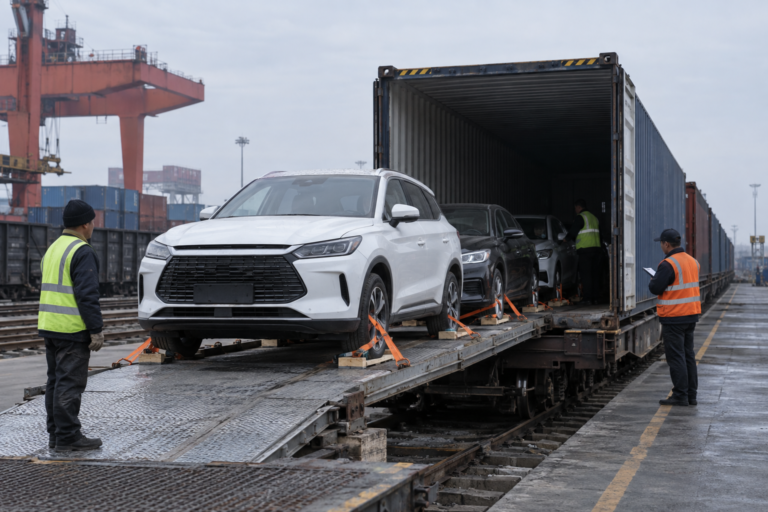
| Inland Logistics (to Port) | $100 – $250 | Based on stuffing 3 units per 40HQ container moved from inland hubs (e.g., Chengdu) to coastal ports. Single-vehicle flatbeds can reach $400-$800 for urgent orders. |
Total Variable Markup: Expect approximately $850 to $1,000 USD per car on top of the net vehicle acquisition price for standard parallel export transactions. ByMotorcar utilizes streamlined export customs clearance at Nansha Port to ensure these costs are optimized without sacrificing compliance.
Beyond the Port: Software Localization & Parts Supply
The single most fatal mistake international dealers make is treating EVs like traditional combustion engines. Sourcing a cheap Chinese EV is easy; maintaining it overseas is the true bottleneck that puts 30% of new parallel importers out of business within their first year. Parallel-exported vehicles almost always arrive with geo-locked infotainment systems, Chinese-only UI interfaces, and disabled Over-The-Air (OTA) update capabilities.
The ByMotorcar “Drive-Ready” Guarantee
- English & Multi-Language Flashing: Before reaching the port, our in-house technical team provides software flashing services to bypass Chinese geo-restrictions. We install English, Russian, or Arabic UI systems and activate local map capabilities where hardware permits—something 90% of our competitors don’t offer.
- OEM Spare Parts Pipeline: A parallel import without parts is a liability. We provide a tailored Fast-Moving Parts Kit (including specific EV air filters, brake pads, suspension components, and high-voltage sensors) shipped alongside your bulk container, ensuring your after-sales center functions from day one.
EV Battery Compliance: Why SOH Diagnostics Are Non-Negotiable
For imported Chinese EVs, drivetrain reliability is almost never the bottleneck. Battery risk is the dominant concern for EU and Middle East buyers. Static Battery Management System (BMS) readings can be extremely misleading. Our quality control team has documented over 50 such cases in the past year where an OEM BMS reported 89% SOH (State of Health), yet independent dynamic testing detected severe cell defects, placing actual SOH at just 42%.
We recently had a client who received a shipment of EVs from another supplier with OEM-reported 92% SOH. Our pre-shipment testing found actual SOH as low as 38% across the entire batch. We helped them reject the shipment and secure a full refund from the supplier.
Navigating EU and GCC Regulatory Fences
- European Union: The EU Batteries Regulation (2023/1542) mandates rigorous supply-chain due diligence. From 2027, digital Battery Passports become mandatory. Euro 7 introduces minimum durability thresholds (80% capacity after 5 years/100,000 km).
- GCC / Saudi Arabia: Saudi Arabia enforces a strict 5-year age limit on used EV imports. Furthermore, obtaining the SABER Certificate of Conformity and ensuring UN38.3/UN3480 certification for lithium-ion packs are hard gates that will result in immediate port rejection if not properly handled.
The ByMotorcar Solution: We do not broker blind inventory. Every zero-mileage or used EV we export undergoes our proprietary SOH diagnostics. We provide fully transparent reports covering cell voltage spread and thermal data, ensuring your fleet passes destination customs seamlessly.
2026 Shipping Bottlenecks: Ro-Ro vs. 40HQ Containers
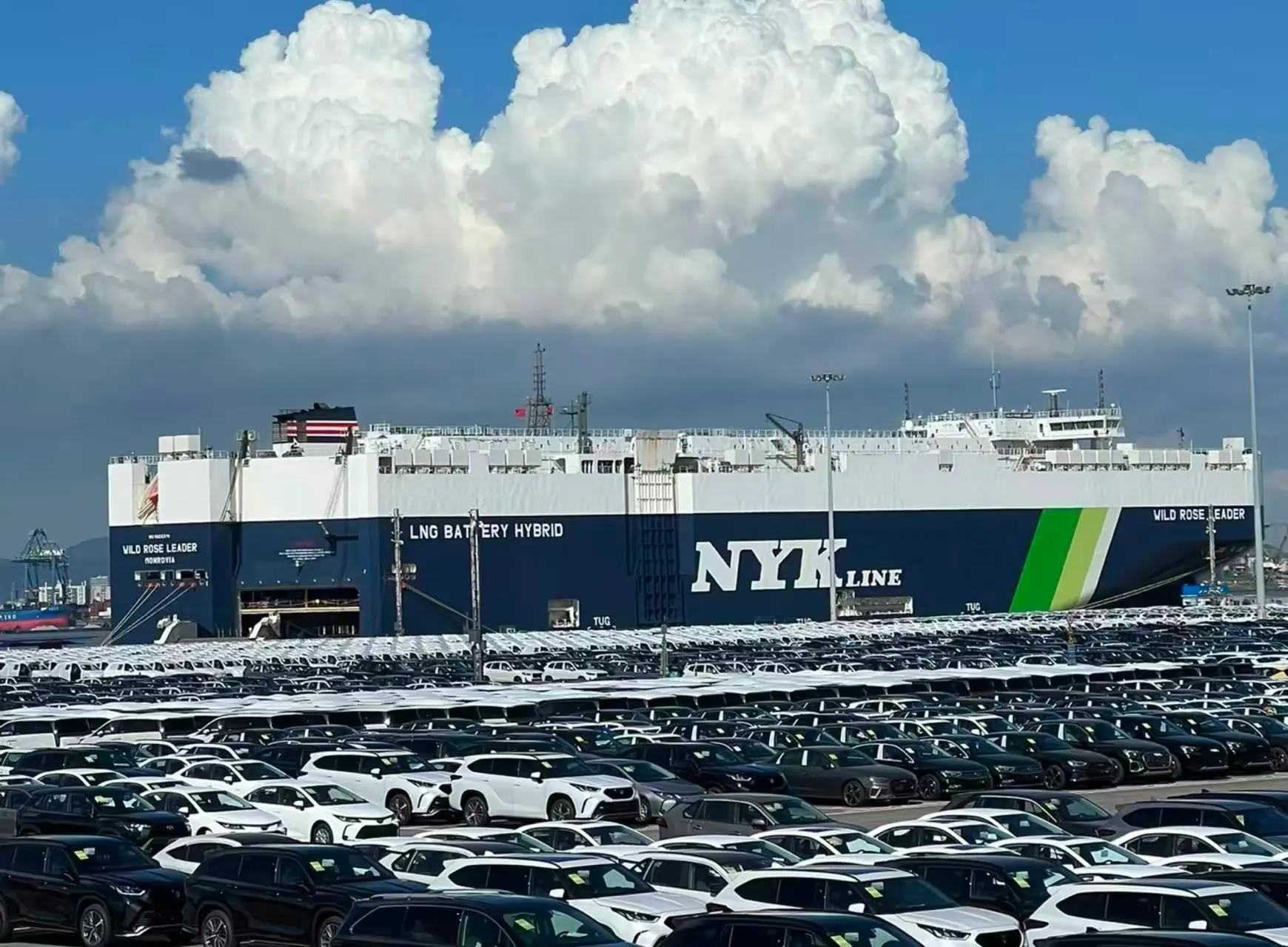
Chinese ports like Shanghai handled 3.63 million vehicles in 2024, but yard congestion and vessel availability are severely bottlenecking supply chains. Ro-Ro (Roll-on/Roll-off) daily charter rates have spiked by 47% since the start of 2026, causing roughly one-third of China’s seaborne car exports to shift to containerized freight.
Dealer-Relevant Operational Trade-offs
For international dealerships, selecting the right freight method directly impacts cash flow and lead times. A 40-foot high cube (40HQ) container can typically hold 3 to 4 midsize sedans or EVs using advanced racking systems. At current 2026 rates of $3,200–$4,800 per 40HQ to Europe, the per-unit ocean freight sits around $1,100–$1,600. While Ro-Ro base rates might appear 30% lower on paper, available slots are routinely monopolized by OEM mega-contracts, leaving independent dealers waiting 6-8 weeks for a spot.
ByMotorcar leverages flexible global bulk order capacity. We treat Ro-Ro as a premium option for homogeneous fleet orders of 50+ units, while deploying expert 40HQ container stuffing for model-mixed parallel exports. This guarantees absolute physical protection from sea air and pilferage, and allows us to offer fixed shipment dates within 30 days of deposit receipt.