Updated: June 2026
Cheap Chinese EV Stock in 2026: What Dealers Must Check Before Paying a Low FOB Price
Low FOB prices for Chinese electric vehicles can look like a perfect opportunity for overseas dealers. China has strong EV production, intense domestic competition, and a fast-growing export pipeline. In 2026, many overseas buyers are receiving attractive offers for BYD, Zeekr, Geely, XPeng, Changan, Leapmotor, Voyah and other Chinese EV stock.
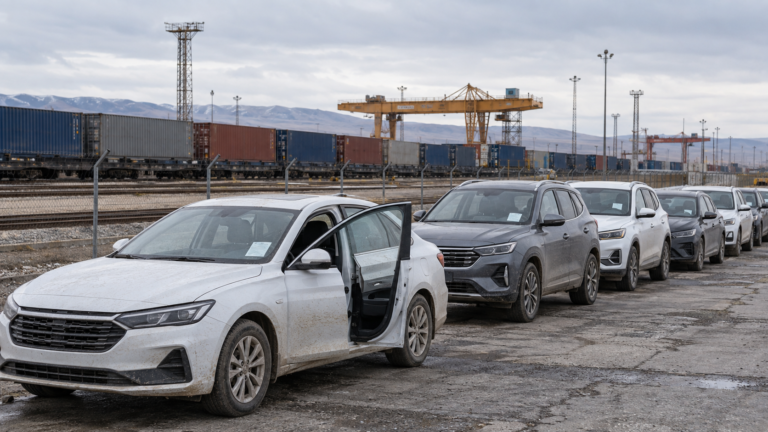
But a low FOB price is not always a clean discount. Sometimes it reflects old stock, mixed production dates, pre-facelift trims, long storage, weak local resale demand, battery uncertainty, China-region software, or charging-standard issues. Before paying a TT deposit, importers should verify the actual stock behind the offer — not just the model name and price.
Short answer: cheap Chinese EV stock can be profitable, but dealers should check VINs, production dates, battery evidence, storage condition, PDI photos, software version, charging port and supplier documents before sending any TT payment.
Why cheap Chinese EV stock is everywhere in 2026
China’s EV export growth is no longer a niche story. According to the IEA Global EV Outlook 2026, China’s electric car exports doubled in 2025 amid an intense domestic EV price war. The IEA notes that exports helped Chinese automakers sustain production volumes and seek better returns in overseas markets.
CPCA data reported by Reuters also showed strong export growth: China’s overall car exports rose 19.4% in 2025 to 5.79 million vehicles, while pure EV exports increased 48.8% to 1.52 million units.
At the same time, the supply side is under pressure. Reuters reported that Chinese auto dealers urged automakers to stop pushing excessive inventory onto dealerships, saying price wars and inventory pressure were damaging profitability. This matters for overseas dealers because distressed domestic inventory can later appear as “ready stock”, “clearance stock” or “special FOB price” offers.
In Europe, Chinese EV and hybrid exports have also become a major trade topic. The Guardian, citing Merics, reported that Chinese EV and hybrid exports to Europe almost doubled year-on-year in the first quarter of 2026. The global demand is real — but so is the risk of overstock and aggressive discounting.
For overseas dealers, the key question is not simply “Can I buy cheap Chinese EVs?” The better question is: what kind of EV stock am I really buying at this low FOB price?
Low FOB price does not always mean low risk
FOB price is only one part of a wholesale EV deal. A cheap offer can still become expensive if the dealer receives old vehicles, outdated trims, weak batteries, incompatible charging ports, China-only software, or units that are hard to resell in the destination market.
Low FOB EV stock usually falls into one of these categories:
| Stock type | Why price may be low | Dealer risk |
|---|---|---|
| Factory-fresh current stock | Supplier has volume access or short-term promotion. | Usually lower risk, but still requires VIN and document checks. |
| Old stock | Vehicle has been stored for months; newer version may already exist. | Battery, tire, 12V battery, software and resale risks. |
| Pre-facelift / old trim | Configuration is no longer the latest market version. | Lower resale value and customer complaints about missing features. |
| Showroom or demo unit | Vehicle has been displayed or test-driven. | Mileage, interior wear, tire wear and battery usage need verification. |
| Mixed batch | Supplier combines units from different sources. | Different production dates, trims, software versions and condition levels. |
If your supplier only sends a model name and a low FOB number, you do not yet have enough information to make a safe buying decision.
The first thing to check: VIN, nameplate and production date
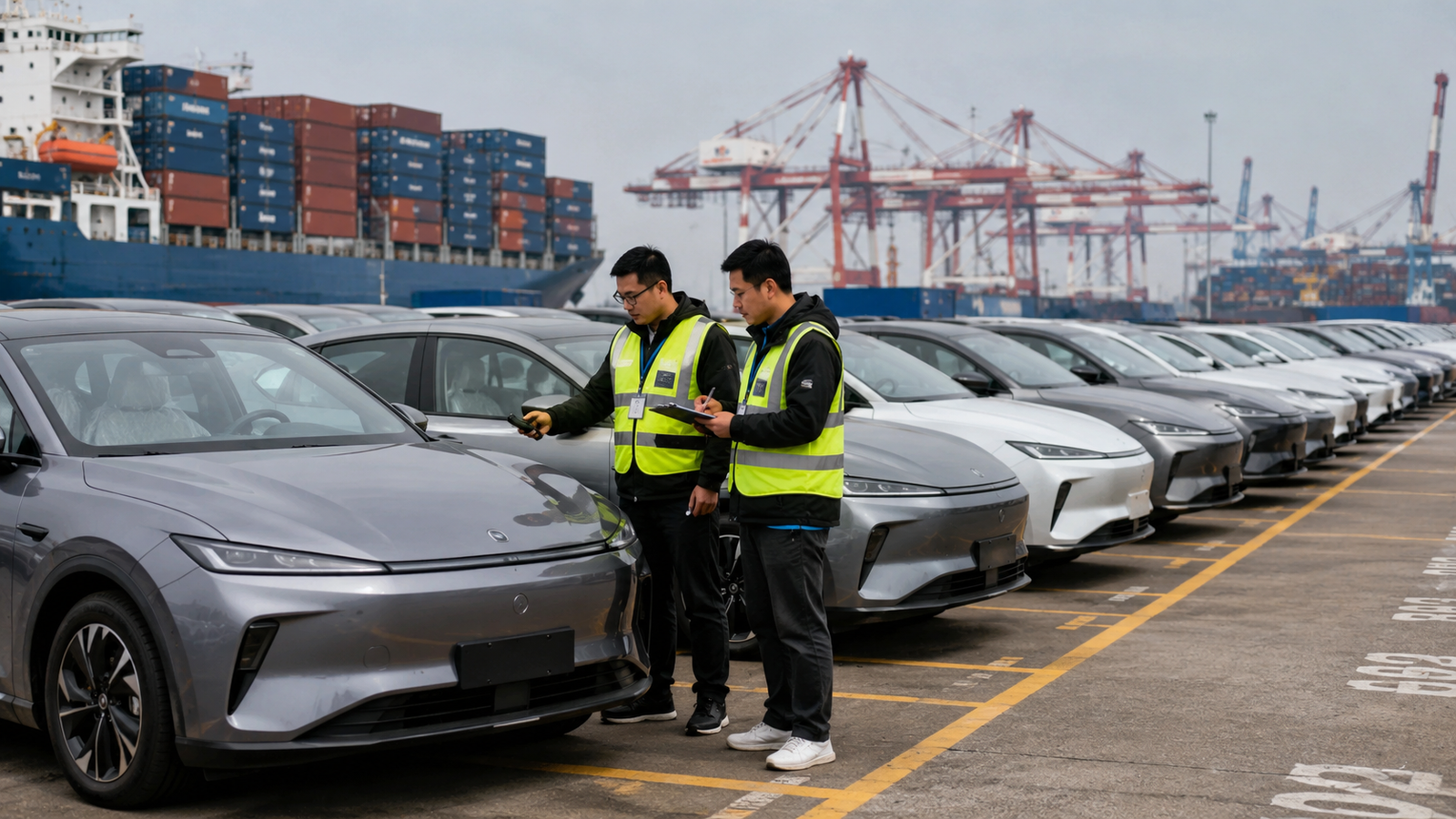
Before you discuss payment, ask for the VIN list and nameplate photos for every unit. The nameplate or build plate usually helps confirm the production month, model information, battery specification and manufacturer details.
For a single-unit purchase, one VIN is enough. For a wholesale batch, you should request a complete VIN list and build-date table. Without that, you cannot know whether you are buying current production, old inventory or a mixed lot.
Ask your supplier for:
- Full VIN list for every unit.
- Clear photo of the VIN plate or nameplate.
- Production month and year for each vehicle.
- Model year and trim version.
- Battery size and motor configuration.
- Real photos of the exact vehicles, not brochure images.
Red flag: if the supplier refuses to show VINs or production dates before deposit, the stock may not be secured, may be older than advertised, or may not match the quoted trim.
Battery risk: do not accept “battery is perfect” without evidence
For EVs, the battery is not just a component. It is the resale value. Even for low-mileage or unused vehicles, long storage, poor state-of-charge management, heat exposure, deep discharge or repeated DC fast charging can create risk.
A dealer does not always need a full laboratory report for every new unit, but the supplier should provide reasonable evidence. For used, demo or aged stock, battery evidence becomes much more important.
Minimum battery evidence to request
- Dashboard photo showing current state of charge and warning lights.
- Charging test photo or short video.
- OBD/BMS screenshot where available.
- Battery SOH report for used or demo vehicles.
- Third-party inspection report for high-value or batch orders.
- Confirmation of storage SOC management if vehicles were parked for months.
For used EVs or demo vehicles, ask for more than a verbal claim. Useful data can include SOH percentage, cell voltage difference, charge cycle count, warning-code scan, or a third-party inspection report from a recognized inspection company.
Bymotorcar can help overseas buyers request and review available China-side battery evidence before payment. However, no supplier should claim a guaranteed battery condition without actual test evidence.
Storage age: cheap EV stock may have been parked for months
Old stock is not automatically bad. Many stored vehicles are still sellable and profitable. The problem is when storage history is hidden. A car parked outdoors for a long time can have tire flat spots, 12V battery issues, brake corrosion, paint exposure, dust contamination or outdated software.
For EVs, storage condition is especially important because the traction battery and 12V system both need proper maintenance.
Ask these questions before TT deposit:
- Where is the vehicle stored: factory yard, dealer yard, indoor warehouse or showroom?
- How long has it been stored?
- Was the traction battery maintained at a safe SOC level?
- Has the 12V battery been charged or replaced?
- Are there recent photos of tires, brake discs and underbody?
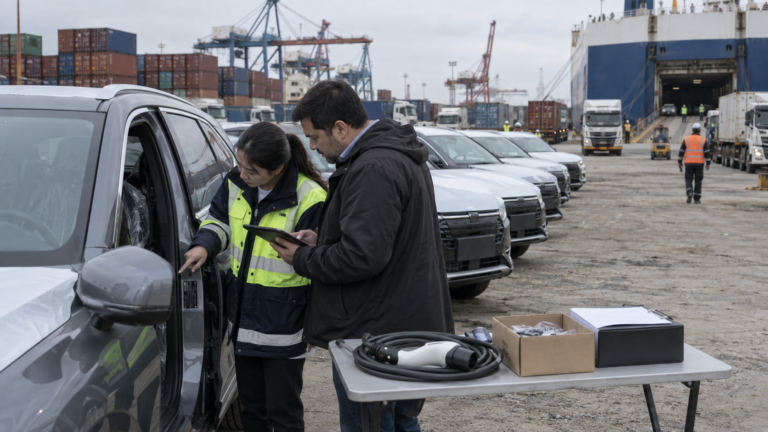
- Can the supplier provide a current PDI photo/video set?
If the supplier says “ready stock” but cannot answer where the vehicles are stored, when they were produced and when the photos were taken, treat the offer as incomplete.
Model year and trim: cheap stock may be an old configuration
Many Chinese EV models receive frequent updates: battery options, cockpit design, ADAS package, heat pump, infotainment processor, charging speed, display layout, software UI, interior materials and driver-assistance features can change between model years.
A low FOB offer might be cheap because it is not the version your local customers expect. A dealer who buys the wrong trim can face slow turnover even if the car is technically new.
Check the configuration per VIN
- Battery capacity and claimed range.
- Motor output and drivetrain.
- Heat pump availability.
- ADAS package and sensor set.
- Infotainment hardware and language support.
- Seat layout, interior color and wheel size.
- Whether it is pre-facelift, facelift or latest model year.
Do not rely on a model name alone. “BYD Dolphin”, “Zeekr 001” or “Geely Geometry” can mean different versions depending on production year, trim, battery pack and domestic-market update cycle.
If you are comparing low FOB offers for BYD vehicles from China or Zeekr EVs from China, make sure each offer includes a VIN-level configuration sheet.
Software, OTA and app risks are often ignored
A smart EV is not just a vehicle. It is also a software product. For many China-market EVs, the infotainment system, app, maps, voice assistant, OTA server and connected services may be designed primarily for Chinese users.
For overseas dealers, this creates a hidden risk: the car may look attractive on price, but customers may complain after delivery if the app does not work, maps are China-only, OTA updates are unavailable, or the interface has limited language support.
Before buying, ask for screenshots or videos showing:
- System language options.
- Software version.
- OTA update status.
- Navigation map coverage.
- Smartphone app region support.
- SIM/eSIM or connected-service status.
- Any warning messages on the vehicle screen.
For some markets, a China-only software setup may still be acceptable if the dealer clearly explains it to customers. For other markets, it can seriously reduce resale value. The key is to know before payment, not after shipment.
Charging standard: GB/T, CCS, Type 2 or something else?
Charging compatibility can decide whether a cheap EV is easy or difficult to sell. China-market EVs commonly use Chinese charging standards. Depending on the destination country, buyers may need adapters, hardware conversion, software changes or special charging infrastructure.
Before paying for a batch, verify the charging port and charging protocol. A car that is cheap FOB but difficult to charge locally may become expensive after import.
Request these details:
- Close-up photo of AC and DC charging ports.
- Charging standard: GB/T, CCS, Type 2, CHAdeMO or other.
- AC onboard charger power.
- DC fast charging support and maximum rate.
- Whether charging adapters are included.
- Whether local conversion is required in your destination market.
This is especially important for dealers selling in the Middle East, Africa, Latin America, Southeast Asia and Europe, where local charging networks may differ from Chinese domestic standards.
What evidence dealers should request before TT deposit
A professional supplier should not ask for a large TT deposit before giving basic evidence. For a cheap EV stock offer, the minimum pre-payment evidence package should include:
| Evidence | Why it matters | If missing |
|---|---|---|
| VIN list | Confirms actual vehicles, not just a quotation. | Stock may not be secured. |
| Nameplate photos | Confirms production date and configuration. | Old stock risk is hidden. |
| Dashboard photos | Shows mileage, SOC and warning lights. | Demo/used condition may be hidden. |
| Battery evidence | Supports SOH or basic EV condition claims. | Battery risk is only verbal. |
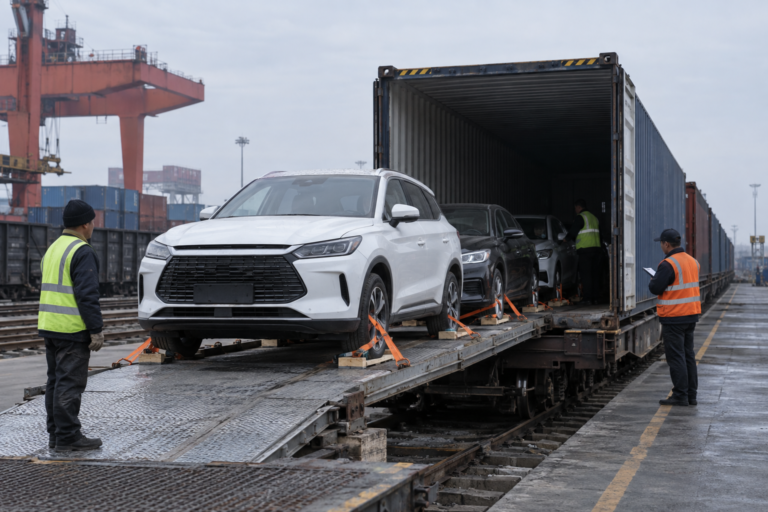
| PDI photo/video set | Documents vehicle condition before shipment. | Disputes after shipping are harder to solve. |
| Charging-port photos | Checks local charging compatibility. | Retrofit cost may appear later. |
| Proforma invoice | Locks VIN, price, Incoterms and payment terms. | Commercial risk remains open. |
If the supplier cannot provide these basic items, the low FOB price should be treated as an incomplete offer, not a confirmed opportunity.
Red flags in cheap Chinese EV wholesale offers
The following signs do not always mean fraud, but they do mean the buyer should slow down and request more proof.
- FOB price is far below market average. Ask why: clearance, old stock, demo units, mixed batch, older trim or urgent cash-flow need?
- Supplier refuses to provide VIN before deposit. Without VIN, you cannot verify the vehicle.
- Production date is hidden. This often points to aged inventory.
- Only stock photos are provided. Brochure images do not prove vehicle availability.
- No dashboard photo. Mileage, SOC and warning lights remain unknown.
- No nameplate photo. Build date and configuration are not confirmed.
- Battery condition is described only verbally. “Perfect battery” is not evidence.
- Trim is unclear. Vague names can hide smaller batteries or missing features.
- Supplier pushes urgent payment. “Pay today or the stock is gone” is common in clearance situations.
- Mixed production dates in one batch. This complicates resale and aftersales explanation.
- Software is China-only. Language, app and map limitations can reduce marketability.
- No PDI before shipment. The dealer takes all condition risk after export.
How to compare a low FOB price with real dealer profit
A low purchase price does not guarantee dealer profit. Before buying, compare the FOB offer with the real retail situation in your country.
Calculate the real margin after:
- Ocean freight or land transport.
- Insurance.
- Port charges.
- Customs duties and VAT/GST.
- Local homologation or inspection.
- Charging-port conversion if needed.
- Software localization if needed.
- Warranty reserve or repair allowance.
- Dealer marketing and holding cost.
A vehicle that is $2,000 cheaper FOB may not be a better deal if it needs charging conversion, has old software, lacks local demand, or requires discounting after arrival.
For broader sourcing context, dealers can also compare current offers with Bymotorcar’s Chinese electric vehicle stock and recent China car export insights on the Bymotorcar news page.
How Bymotorcar helps review cheap EV stock before payment
Bymotorcar is a China-side vehicle sourcing and export coordination service for overseas B2B buyers. We do not tell dealers to buy every cheap EV offer. We help buyers look at the evidence behind the price.
Before a TT deposit, Bymotorcar can help review:
- Vehicle availability in China.
- VIN and nameplate consistency.
- Production date and model-year information.
- Trim and configuration details.
- Dashboard photos, mileage and SOC.
- Charging-port photos and standard information.
- Basic stock condition photos and videos.
- PDI evidence where available.
- Supplier documents and proforma invoice details.
- Basic China-side export readiness.
Important boundary: Bymotorcar can help review China-side vehicle and supplier evidence. We do not guarantee battery SOH without test data, overseas manufacturer warranty, destination-country customs clearance, local homologation, registration, or tax outcomes. These must be confirmed by the importer, local broker, workshop or relevant authority in the destination market.
This positioning is important. A reliable sourcing partner should not promise what cannot be proven. The goal is to reduce blind payment risk before money leaves the buyer’s account.
Dealer checklist: what to send Bymotorcar for a stock review
If you have received a low FOB offer from a Chinese EV supplier, send the following items before paying a TT deposit:
- Supplier company name and contact.
- Target model, brand and quantity.
- FOB port and Incoterms.
- Quoted unit price.
- VIN list if available.
- Photos or videos received from the supplier.
- Proforma invoice draft.
- Destination country.
- Whether the vehicles are claimed as new, showroom stock, demo, used or clearance stock.
- Any urgent payment deadline or supplier condition.
With this information, Bymotorcar can help identify what is missing, what looks inconsistent and what should be checked before payment.
FAQ: buying cheap Chinese EV stock in 2026
Why are some Chinese EV FOB prices so low in 2026?
Low prices can come from real promotions, export competition, dealer inventory pressure, old stock, mixed batches, pre-facelift trims or clearance deals. The reason matters because each scenario carries different risk.
How do I know if the EV is old stock?
Ask for VINs, nameplate photos, production dates, storage location and current vehicle photos. A supplier who cannot show production date and exact-unit photos should not be treated as fully verified.
Should I request battery SOH for new EV stock?
For factory-fresh current stock, dashboard and basic charging evidence may be acceptable. For used, demo, aged or high-value stock, ask for SOH evidence, OBD/BMS data or third-party inspection.
What is the biggest risk with long-stored EVs?
The main risks are traction battery management, 12V battery failure, tire flat spots, brake corrosion, outdated software and hidden cosmetic issues. These should be checked through photos, video and PDI evidence.
Can China-market EV software work overseas?
Sometimes yes, sometimes with limitations. Buyers should verify language options, map coverage, app region, OTA update status and connected services before buying.
Why does charging standard matter?
If the vehicle uses a charging port or protocol not common in the destination market, the dealer may need adapters, conversion or special infrastructure. This can affect resale value.
What should be included in the proforma invoice?
The PI should list model, trim, VINs, unit price, quantity, FOB port, Incoterms, payment terms, shipment terms and any included PDI or inspection service.
Is a low FOB price always suspicious?
No. Some low prices are legitimate. But a very low price without VINs, production dates and real photos is incomplete. Price should be verified together with evidence.
Can Bymotorcar guarantee battery SOH?
Bymotorcar can help request and review available battery evidence, but no one should guarantee SOH without proper test data or third-party inspection.
What is the safest way to buy cheap Chinese EV stock?
Do not pay only based on a price list. First review VINs, production dates, battery evidence, PDI photos, software readiness, charging compatibility, supplier documents and payment terms.
Sources and further reading
- IEA Global EV Outlook 2026 — China EV export growth, price-war context and global trade data.
- Reuters / CPCA data — China car export and pure EV export growth in 2025.
- Reuters dealer inventory report — Chinese dealer complaints about inventory pressure and price wars.
- The Guardian / Merics — Chinese EV and hybrid export growth into Europe in early 2026.
- CarNewsChina / CAAM data — monthly NEV export acceleration and export share context.
Conclusion: buy the evidence, not just the low FOB price
Cheap Chinese EV stock can be a real opportunity for overseas dealers in 2026. China’s export scale, manufacturing capacity and price competition can create attractive buying windows. But the same market conditions can also push old inventory, mixed batches and weakly documented vehicles into export channels.
Before you pay a TT deposit, verify the exact stock: VIN, nameplate, production date, model year, battery evidence, storage condition, software, charging standard, PDI photos and supplier paperwork. A low FOB price should start a due-diligence process — not replace it.
Got a low FOB offer for Chinese EV stock?
Send Bymotorcar the supplier quote, VIN list, model year, production date, photos and proforma invoice before you pay the TT deposit. We can help review China-side vehicle availability, stock condition evidence, PDI materials and basic export readiness.