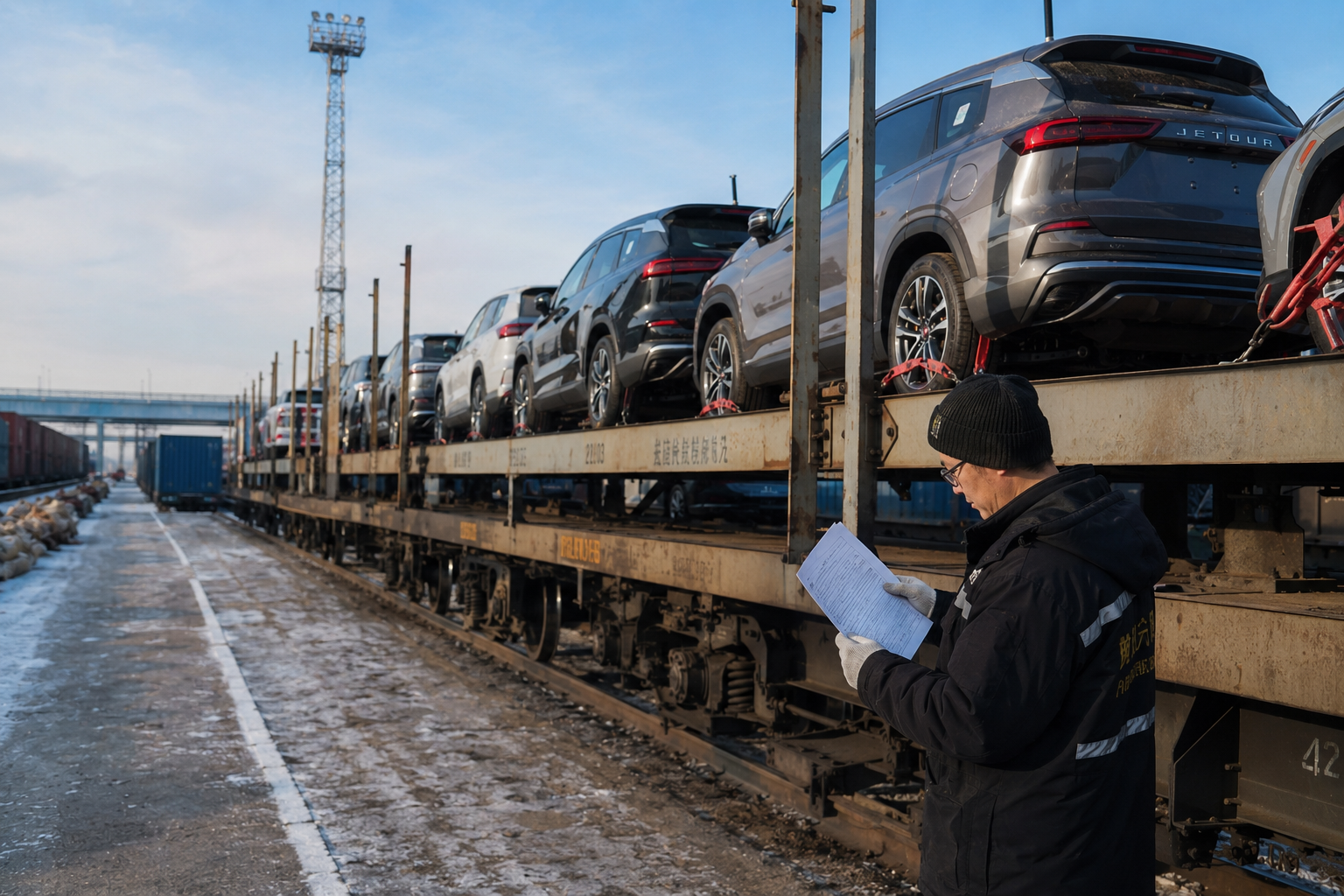
Updated: July 2026
Russia-Bound Chinese Cars: Dealer Risk Checklist Before Paying a China Supplier
Russia is one of the largest and most complex destinations for Chinese vehicles. For dealers, importers and fleet buyers, the biggest mistake is treating a Russia-bound order as a simple price-and-shipping deal. Before any deposit is paid to a China supplier, the buyer must understand the exact car, supplier status, China export readiness, Russia-side broker requirements, SBKTS/EPTS route, recycling fee exposure and payment feasibility.
This guide is not a generic “how to import a car from China to Russia” article. It is a B2B risk-control checklist for buyers who source Chinese vehicles in China and need to hand a clean China-side vehicle file to their Russian broker or importer.
Short answer: Bymotorcar can help Russia-bound buyers verify exact cars in China, collect VIN/nameplate/photos/PDI evidence, check export-readiness risks, prepare China-side export documents and coordinate FOB/FCA/CIF or logistics handoff where available. Russian customs clearance, SBKTS, EPTS, recycling fee, taxes, registration, insurance and local warranty must be confirmed by the Russian importer and licensed broker.
Why Russia-Bound Chinese Car Sourcing Is High-Volume but High-Complexity
Russia remains a major destination for Chinese vehicles, but volume does not mean simplicity. Chinese brands expanded rapidly in Russia after many Western and Japanese automakers stopped direct supply, and Reuters has reported that even some non-Chinese vehicles have reached Russia through China-based resale channels. Source: Reuters.
For Chinese cars, the opportunity is real: SUVs, crossovers, EVs, PHEVs, REEVs and premium models all have demand in Russia. But the risk is also real. Russia-side requirements such as SBKTS, EPTS, customs valuation, recycling fee and registration can change the economics of a deal. China-side export rules can also affect whether a “new,” “demo” or “zero-mileage used” vehicle is actually export-ready.
That is why the safest workflow is not “find cheap FOB price first.” It is:
- confirm the Russia-side compliance route with a broker;
- verify the exact vehicle in China;
- check export readiness and supplier capability;
- agree payment and refund conditions;
- only then pay the deposit.
What Russian Dealers Must Verify Before Paying a China Supplier
Before sending any deposit, the buyer should verify both the commercial offer and the exact physical unit. A model name, stock photo and attractive price are not enough for a Russia-bound order.
Minimum checks before deposit
- exact model, trim and drivetrain;
- VIN and nameplate photos from the exact vehicle;
- production date;
- new, demo or used status;
- China registration date if any;
- mileage and dashboard photo;
- engine, battery and fuel type;
- LHD confirmation;
- full exterior, interior, underbody and dashboard photos;
- PDI photos, inspection report or diagnostic screenshots;
- supplier’s export capability and contract entity;
- refund terms if export authorization or Russian clearance fails.
This is where a China-side sourcing partner adds value. The goal is not just to find a vehicle, but to make the vehicle file reliable enough for the buyer’s Russian broker to review before shipment.
China-Side Vehicle File vs Russia-Side Broker File
Russia-bound orders should be split into two separate files. The first file is created in China. The second file is handled in Russia by the importer and broker. Confusing these two files leads to disputes, delays and unexpected costs.
| File | Who prepares or verifies it? | Main purpose |
|---|---|---|
| China-side vehicle file | Bymotorcar / China-side supplier / inspection team | Prove the exact car, VIN, condition, trim, export documents and shipment handoff. |
| Russia-side broker file | Russian importer, customs broker, certification body and registration partners | Handle customs clearance, SBKTS, EPTS, recycling fee, taxes and registration. |
A clean China-side file does not replace Russian broker work. A broker’s estimate does not prove the car in China exists in the promised condition. Both files must be aligned before the buyer commits money.
EPTS, SBKTS and Recycling Fee: Modules for Your Russian Customs Broker
Russia-side compliance is not something a China-side exporter should promise. Imported vehicles need the correct customs route, conformity evidence and registration path. In practice, Russia-bound cars are usually discussed around three key modules: SBKTS, EPTS and recycling fee.
SBKTS
SBKTS is commonly used for individual or small-batch imported vehicles to confirm compliance with the EAEU technical regulation on the safety of wheeled vehicles. The relevant EAEU framework is TR CU 018/2011, which sets safety requirements for vehicles used on public roads in the EAEU market. Source: Eurasian Economic Commission.
EPTS
EPTS is the electronic vehicle passport needed for registration in Russia. The Russian importer or local service provider must confirm how the EPTS will be issued based on customs data, SBKTS or applicable type-approval documentation.
Recycling fee
The recycling fee can be one of the largest cost variables for Russia-bound vehicles, especially for legal entities, powerful vehicles, hybrids and EVs. Rhodium Group noted that recycling fee increases have materially changed the economics for Chinese carmakers and exporters in Russia. Source: Rhodium Group.
Important: Bymotorcar does not calculate or guarantee Russian customs duty, VAT, recycling fee, SBKTS, EPTS or registration. These must be confirmed by the buyer’s Russian customs broker before any deposit is paid.
China-to-Russia Logistics: Rail, Road, Ports and Handoff Points
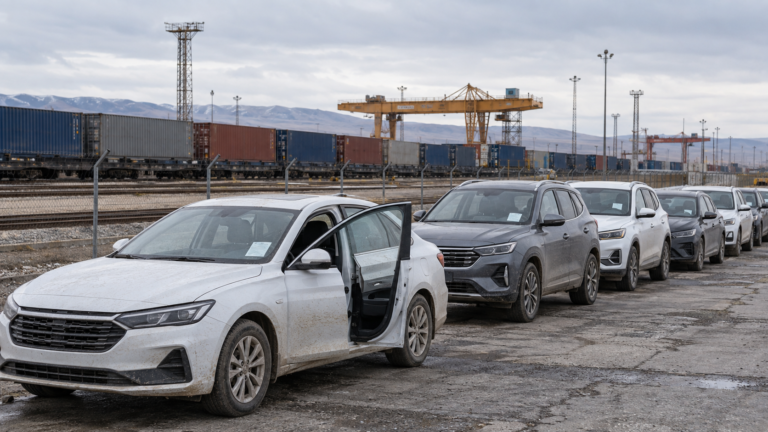
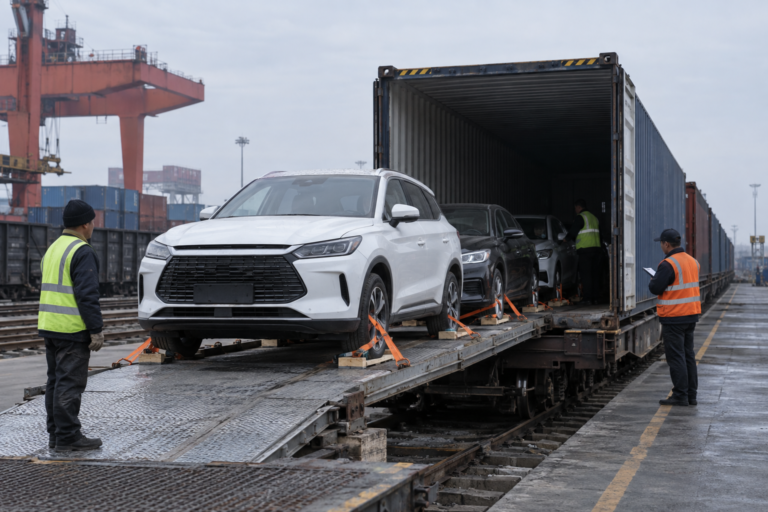
China-to-Russia vehicle logistics can use multiple routes: rail, road, container, car carrier, Far East ports and border crossings. The best route depends on the model, volume, supplier location, destination city, seasonal conditions and broker plan.
Common logistics options
- Rail container routes: useful for structured shipments and dealer batches.
- Road and car-carrier routes: practical for certain border and inland delivery scenarios.
- Far East port routes: relevant for Vladivostok and onward inland movement.
- Multimodal routes: rail + road, sea + rail or border handoff depending on the deal.
Major logistics references often discuss crossings and hubs such as Manzhouli/Zabaikalsk, Suifenhe/Pogranichny, Heihe/Blagoveshchensk, Vladivostok and Moscow-area delivery. But a safe quote must be made case by case. Border capacity, insurance, payment issues, customs inspection and seasonal delays can change the plan.
Documents used in logistics handoff
- commercial invoice;
- packing list;
- bill of lading, CMR or railway waybill depending on route;
- certificate of origin where available;
- China export declaration;
- transport insurance document if applicable;
- vehicle photos and PDI evidence for condition record.
Bymotorcar can coordinate China-side logistics handoff where available. However, Russian customs clearance, inland registration and local release remain Russia-side responsibilities.
China Export-Readiness Risks: New, Demo and “Zero-Mileage Used” Cars
One of the biggest China-side risks for Russia-bound sourcing is whether the vehicle is truly export-ready. This became more important with China’s tighter treatment of “zero-mileage used cars.”
Industry reporting says that from 2026, cars exported within 180 days of initial registration require after-sales service confirmation or manufacturer-backed export documentation. The rule targets the practice of registering new cars as used vehicles for export. Source: CarNewsChina.
This article should not turn into a separate 180-day rule guide. For Russia-bound B2B buyers, the practical point is simple: before paying a deposit, verify the supplier’s ability to export the exact unit legally.
Ask before deposit:
- Is the car new, demo, used or previously registered in China?
- What is the China registration date, if any?
- Does the vehicle require manufacturer after-sales confirmation?
- Can the supplier provide export documentation for this exact VIN?
- What happens if export authorization is denied?
- Is there a written refund or substitution clause?
A low FOB price is not useful if the vehicle cannot leave China cleanly or if the buyer is pushed into opaque workarounds.
EV, PHEV, REEV and Petrol Choices for Russian Winter and Long-Distance Use
Russia is not one driving environment. Moscow, St Petersburg, Siberia, the Far East and southern regions have different winter temperatures, charging access, service networks and buyer expectations. Vehicle suitability should be evaluated by use case.
| Vehicle type | Best Russia use case | Pre-shipment checks |
|---|---|---|
| BEV | Large cities, controlled charging, warm parking, predictable routes. | Battery SOH, heating, winter range, charging port, software, OTA, service support. |
| PHEV / REEV | Mixed city/highway use, family buyers, long-distance routes, flexible energy use. | Battery, engine/generator, fuel system, hybrid modes, service, recycling fee exposure. |
| Petrol SUV / crossover | Regional dealers, family buyers, winter use, simpler service and resale. | Engine, gearbox, corrosion protection, suspension, ground clearance, spare parts. |
EVs and PHEVs should not be sold into Russia only by CLTC range or dashboard technology. Battery heating, winter range loss, GB/T vs CCS2, charging access, Russian/English interface, app availability, OTA updates and local service all matter.
For many regional dealers, petrol SUVs and crossovers remain the most predictable segment. For premium urban buyers, Li Auto, Zeekr, BYD, Voyah, Avatr and other advanced models can be attractive, but they require deeper software, battery, charging and service checks before shipment.
VIN, LHD, PDI, Battery and Software Checks Before Shipment
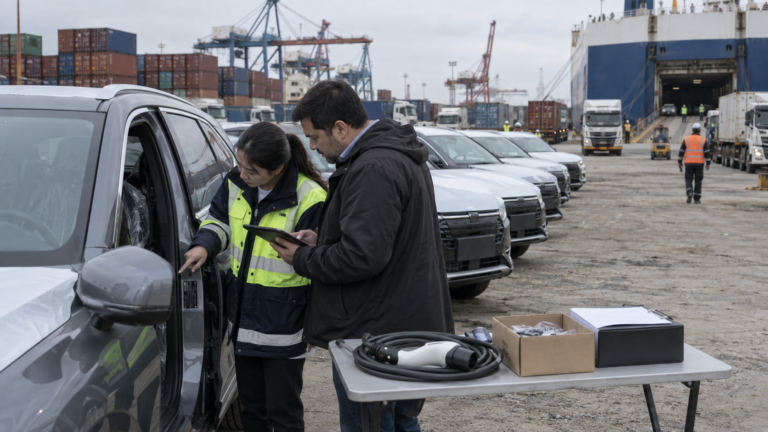
The strongest way to reduce Russia-bound order risk is to document the exact vehicle before it leaves China. The buyer should receive proof that matches the invoice, logistics file and broker review.
Exact-car evidence to collect
- VIN and nameplate photos;
- chassis stamp or factory label where accessible;
- full exterior and interior photo set;
- dashboard photo showing mileage and warning lights;
- production date and trim confirmation;
- PDI photos or inspection video;
- underbody and tire photos;
- engine bay or battery compartment photos where applicable;
- damage, flood, paintwork and accident evidence for used or demo units;
- software language screenshots;
- navigation, app pairing and OTA status screenshots;
- charging-port photo and cable/accessory list for EV/PHEV/REEV.
For dealer batches, the same discipline should apply to every VIN, not only one sample unit.
Documents Bymotorcar Can Prepare in China
Bymotorcar can help prepare or coordinate the China-side export and shipment file. The exact documents depend on supplier, route, vehicle type and Incoterms.
- commercial invoice with VIN, model, trim and agreed Incoterms;
- packing list;
- bill of lading, CMR or railway waybill depending on route;
- certificate of origin where available;
- China export declaration support where applicable;
- supplier contract or proforma invoice;
- PDI photos and vehicle evidence file;
- export-readiness support documents where available;
- technical data to share with the Russian broker for HS/TN VED and SBKTS/EPTS review.
The buyer’s Russian broker should review document wording, invoice structure, HS/TN VED classification, vehicle type, powertrain, customs value and compliance path before shipment.
What the Russian Importer and Broker Must Confirm Locally
Russia-side work belongs to the importer, customs broker, certification body and registration partners. This must be stated clearly in every Russia-bound order discussion.
The Russian broker/importer should confirm:
- customs clearance route;
- customs valuation;
- HS / TN VED EAEU code;
- import duty, VAT and excise if applicable;
- recycling fee exposure;
- SBKTS or OTTS route;
- EPTS issuance process;
- GIBDD registration path;
- local insurance;
- warranty and service support;
- spare-parts supply;
- EV charging compatibility and local charging plan;
- whether the vehicle is imported for Russia only or for another EAEU route.
Bymotorcar can work alongside the buyer’s broker by making the China-side file cleaner, but it should not replace the broker or promise Russia-side outcomes.
Payment and Compliance: Do Not Treat Settlement as a Detail
Russia-related payments can face banking, sanctions and compliance restrictions. Reuters reported that payment problems between Russia and China disrupted Chinese car imports, with smaller importers hit especially hard by delayed or bounced payments. Source: Reuters.
For B2B buyers, payment feasibility should be confirmed before deposit, not after the vehicle is found. Buyers should consult their bank, customs broker and legal or compliance adviser on lawful payment routes. Bymotorcar should not promise sanctions workarounds, fake consignees, third-country disguises or opaque routing.
Payment red flags
- the seller says “payment is easy” but cannot explain the contract entity;
- invoice party, bank beneficiary and actual supplier do not match;
- the buyer is asked to use a vague third-party account;
- refund terms are unclear if export approval fails;
- the seller suggests misdeclaring the goods or consignee;
- the buyer has not checked the route with its bank before deposit.
Dealer Master Checklist: Russia-Bound Chinese Vehicles
| Check item | Why it matters | Who confirms? |
|---|---|---|
| Supplier export capability | Some vehicles may require manufacturer-backed export documents or after-sales confirmation. | Bymotorcar + supplier |
| VIN and nameplate | Confirms exact unit and avoids stock-photo deals. | Bymotorcar |
| China registration date | May affect 180-day export-readiness risk. | Bymotorcar + supplier |
| PDI evidence | Documents vehicle condition before shipment. | Bymotorcar |
| SBKTS / EPTS route | Required for Russia-side compliance and registration. | Russian broker / certifier |
| Recycling fee estimate | Can materially change landed cost. | Russian broker |
| Payment route | Banking restrictions can delay or block settlement. | Buyer’s bank / compliance adviser |
FAQ: Chinese Cars for Russia Dealers and Importers
How should a Russian dealer verify a Chinese supplier before paying a deposit?
Ask for supplier identity, contract entity, VIN-level vehicle evidence, export-readiness proof, PDI photos, refund terms and route feasibility before any payment.
What is the difference between the China-side vehicle file and the Russia-side customs file?
The China-side file proves the exact car, condition, documents and shipment handoff. The Russia-side file handles customs clearance, SBKTS, EPTS, recycling fee, taxes and registration.
Can Bymotorcar handle SBKTS and EPTS?
No. Bymotorcar can prepare China-side documents and vehicle evidence, but SBKTS and EPTS must be handled by the Russian importer, broker and certification partners.
What does China’s 180-day export rule mean for Russia-bound cars?
It means buyers must verify whether the vehicle is new, demo, used or recently registered in China and whether manufacturer-backed export documents or after-sales confirmation are needed.
Are Chinese EVs suitable for Russia?
They can be suitable for large cities and controlled users with reliable charging and warm parking, but buyers must check winter range, battery heating, charging standard, software and local service.
Are PHEV and REEV models better for Russia than BEVs?
PHEV and REEV models can be more flexible for long-distance and mixed use, but they still require careful checks on battery, engine/generator, service and recycling fee exposure.
Which Incoterms are safer for China-to-Russia vehicle orders?
FOB, FCA, CIF or DAP can all be used depending on route and responsibility. The key is to define where Bymotorcar’s China-side responsibility ends and where the Russian broker/importer takes over.
Can Bymotorcar calculate the Russian recycling fee?
No. The recycling fee must be calculated by the Russian broker based on current rules, vehicle type, powertrain, importer status and customs classification.
What should be checked for dealer batches?
Every VIN should have its own photo file, nameplate, PDI evidence, invoice line, logistics reference and broker review. Do not rely on one sample vehicle for the entire batch.
Can Bymotorcar guarantee payment or customs clearance for Russia?
No. Buyers must confirm lawful payment channels with their bank and advisers. Russian customs clearance and registration must be handled by the buyer’s licensed broker and local partners.
Sources and Further Reading
- Reuters: foreign cars flowing to Russia through China — market and trade-route context.
- Reuters: payment problems stifle Chinese car imports — payment and compliance risk context.
- Eurasian Economic Commission: TR CU 018/2011 — EAEU technical regulation for wheeled vehicles.
- Rhodium Group: Chinese carmakers in Russia — recycling fee and market-policy context.
- CarNewsChina: 180-day export rule — China-side export-readiness risk for recently registered cars.
Conclusion: Russia Orders Should Be Verified Before the Deposit, Not After Shipment
Russia remains a major opportunity for Chinese vehicle sourcing, but it is not a simple destination. A dealer must check the exact car in China, confirm supplier export readiness, prepare a clean China-side document file, and coordinate with a Russian broker on SBKTS, EPTS, recycling fee, customs valuation, taxes and registration before paying a deposit.
The dealers who manage risk early will avoid the most expensive mistakes: wrong-spec cars, missing VIN evidence, unclear export authorization, unrealistic recycling fee assumptions, payment delays and Russia-side compliance surprises.
Need China-Side Help for Russia-Bound Vehicle Orders?
Send Bymotorcar your target model, quantity, preferred route, Russian broker checklist and payment conditions. We can help verify the exact car in China, collect VIN/nameplate/PDI/battery evidence, prepare China-side export documents and coordinate FOB/FCA/CIF or logistics handoff where available. Your licensed Russian broker should confirm customs clearance, SBKTS, EPTS, recycling fee, taxes, registration and local compliance before you place the order.