Updated: August 2026
China Car Sourcing in 2026: Why the Cheapest FOB Car May Lose to the Local Version
A low China FOB price can still be attractive. But for overseas dealers, importers and fleet buyers, it is no longer enough to compare one China quotation with one local selling price. Chinese brands are expanding through local assembly, official distributors, regional parts channels and market-specific versions.
The real question is now more precise: is this exact China-market VIN still a better commercial buy than the locally assembled or officially distributed version?
Dealer takeaway:
- A lower China FOB price does not prove better stock if the local version has warranty, parts, software and resale support.
- China sourcing still works when the local channel lacks supply, trim choice, fleet configuration or commercial-vehicle options.
- Before deposit, compare the exact China-market VIN against the local official version—not just the badge, model name or FOB quote.
This is not an argument against China sourcing. It is an argument against lazy sourcing. A China-market vehicle can still be the right deal, but only when the buyer understands what local assembly, official warranty, software, parts and resale do to the real cost of stock.
Bymotorcar’s role: We help from the China side with vehicle sourcing, VIN/nameplate evidence, trim verification, PDI photos, supplier coordination, export-side documents and FOB/FCA/CIF handoff where available. Destination-country customs clearance, homologation, tax calculation, registration, local warranty, insurance, importer-of-record service and after-sales repair must be confirmed by the buyer’s local partners.
The Cheapest FOB Car Can Lose After the First Service Visit
FOB price is visible. After-sales risk is not. That is why a China quotation can look better on day one and weaker after the first warranty dispute, delayed spare part, software complaint or registration question.
A locally assembled or officially distributed vehicle may cost more at the first quotation, but it may include things a dealer has to buy separately for China-market stock: trained technicians, faster parts, local warranty handling, known recall channels, local-language software, finance acceptance and stronger resale trust.
The better comparison is simple: China landed cost plus risk reserve versus the local version’s full commercial value.
Chinese Brands Are No Longer Export-Only
Chinese automakers are no longer relying only on finished-vehicle exports. BYD, Geely, SAIC, GWM, Chery and other groups have been expanding through overseas plants, CKD/SKD assembly, regional production hubs and local partnerships in markets such as Brazil, Egypt, Thailand, Indonesia, Mexico and Central Asia.
For a dealer, the factory headline is not the main point. The main point is that a local benchmark may now exist. If a Geely model is locally assembled in Egypt, a BYD model is locally supplied in Brazil, or a Chinese EV has an official channel in Southeast Asia, a direct China-stock unit must justify why it is still better.
Local production does not automatically make local stock cheaper, better equipped or legally easier. Tariffs, incentives, origin rules, local-content policies and supply conditions differ by country. But localization does add a sourcing filter: do not import before comparing the exact China unit with the local alternative.
Same Badge, Different Vehicle
A shared model name can mislead buyers. The local version and the China-market version may look similar in photos, but they can differ in the areas that decide dealer profit.
- battery capacity, chemistry, supplier or thermal calibration;
- engine, hybrid system, drivetrain or motor output;
- charging inlet, AC/DC charging rate and cable package;
- software language, app region, maps, OTA eligibility and connected services;
- ADAS hardware, enabled functions and regional map dependence;
- emissions, lighting, tyre rating, glazing and climate package;
- part numbers, diagnostic compatibility and recall route;
- warranty provider, territory and claim process.
For example, Geely’s Egypt CKD production of Emgrand and Coolray means an Egypt buyer should compare a China-sourced Emgrand or Coolray VIN against the locally built version. The answer is not automatic. China stock may still win on price or specification, while the local unit may win on warranty, parts and buyer confidence.
Local Assembly Changes the Dealer’s Math—But Not Always in Its Favor
Local assembly can improve the business case for local stock, but it is not a magic rule. A CKD vehicle may still use imported kits. Local parts supply may still be developing. Dealer allocation may be limited. Official stock may be overpriced or unavailable in the trim the buyer needs.
That is why the dealer should test the deal across five lines, not one:
| Decision line | Local version may win if… | China sourcing may still win if… |
|---|---|---|
| Supply | The distributor has immediate stock and stable allocation. | Local lead time is long or the required trim is unavailable. |
| Service | Local workshops, parts and warranty are already in place. | The buyer has its own workshop, parts channel or fleet maintenance team. |
| Specification | The local version is homologated and correctly adapted. | The China version has a verified commercial, seating, battery or body advantage. |
| Resale | End buyers trust official stock and finance providers accept it more easily. | The market has strong demand for that China-spec model despite parallel-import status. |
| Margin | The China price gap disappears after risk costs. | The landed-cost gap remains large after freight, tax, software, parts and warranty reserve. |
Where the Region Changes the Answer
This article is not a country guide, but regional context matters.
- Latin America: compare China FOB against official distributor price, local finance, parts availability and local assembly where present.
- MENA: check heat adaptation, Arabic/English software, local warranty, charging support and official network strength.
- Africa: commercial vehicles, buses, pickups and vans may still favor China sourcing if the buyer can manage parts and workshop support.
- CIS: software language, charging standard, winter use, registration path and resale confidence can matter more than one low FOB number.
- Southeast Asia: local EV/PHEV incentives, distributor networks and local production can make official stock harder to beat.
The decision is never “local or China” in the abstract. It is local version versus exact China VIN, in one market, for one buyer type.
When China Sourcing Still Makes Sense
Direct sourcing from China remains strong when it solves a supply problem the local channel cannot solve.
- The model, body style or powertrain is not sold locally.
- The local distributor has long lead times or restricted allocation.
- The China-market trim has a verified fleet, seating, cargo, battery or powertrain advantage.
- The buyer needs buses, vans, trucks, pickups or special commercial configurations.
- The importer has its own workshop, parts channel or service partner.
- The market has weak official coverage or no suitable local version.
- The price gap remains strong after freight, taxes, certification, parts and warranty reserve.
- The exact VIN, export readiness, specification and PDI evidence are confirmed before deposit.
A China-sourced vehicle is not automatically risky. An unverified China-sourced vehicle is.
When the Local Version Is Usually Safer
Local official stock often becomes the better choice when the buyer’s business depends on trust after the sale. This is especially true for retail dealers, finance-backed sales, taxi fleets, hotel shuttles, school transport, delivery fleets and first-time EV buyers.
- The same relevant trim is available with enforceable local warranty.
- The vehicle is an EV or PHEV with battery, charging and software dependence.
- The dealer has no high-voltage repair partner or parts reserve.
- The buyer needs fast resale, finance acceptance or trade-in support.
- Local assembly provides a similar specification with easier service.
- The non-local version has unclear homologation or registration treatment.
- The full risk-adjusted China cost is close to the local purchase cost.
The dealer does not lose because the China car is bad. The dealer loses when the imported unit asks for a level of support the business cannot provide.
Buyer Scenarios: Same FOB Quote, Different Decision
Small LATAM Dealer
A cheaper China-market SUV may work if the local distributor has no supply. If the local version has warranty, finance support and parts, the FOB gap must be large enough to justify the risk.
Middle East EV Fleet
China EV pricing can be attractive, but the buyer must check heat package, charging, battery support, Arabic/English software and fleet uptime before deposit.
African Commercial Importer
For buses, vans and trucks, China sourcing may beat local stock when custom body, payload or volume matters. The spare-parts and workshop plan must be part of the purchase.
Buyer With Own Workshop
A buyer with diagnostics, technicians and parts access can accept risks that a retail dealer cannot. That does not remove the need for VIN, PDI and software proof.
The Missing Line in FOB Comparisons: After-Sales Reserve
A proper FOB comparison should include a reserve for the work the local official channel may already include in its price.
| Reserve item | Dealer question |
|---|---|
| Parts | Which filters, panels, sensors, lights, tyres and high-voltage parts should be stocked before sales begin? |
| Warranty | Who pays if the battery, motor, inverter, infotainment unit or ADAS sensor fails? |
| Software | Will the language, maps, app, OTA and connected services work in the destination market? |
| Delay | What happens if homologation, inspection, registration or importer paperwork takes longer than expected? |
| Resale | Will customers discount the vehicle because it is China-market or parallel-import stock? |
If the China price advantage disappears after these lines are added, local stock may be the smarter business decision.
Compare the Exact VIN Before You Compare the Price
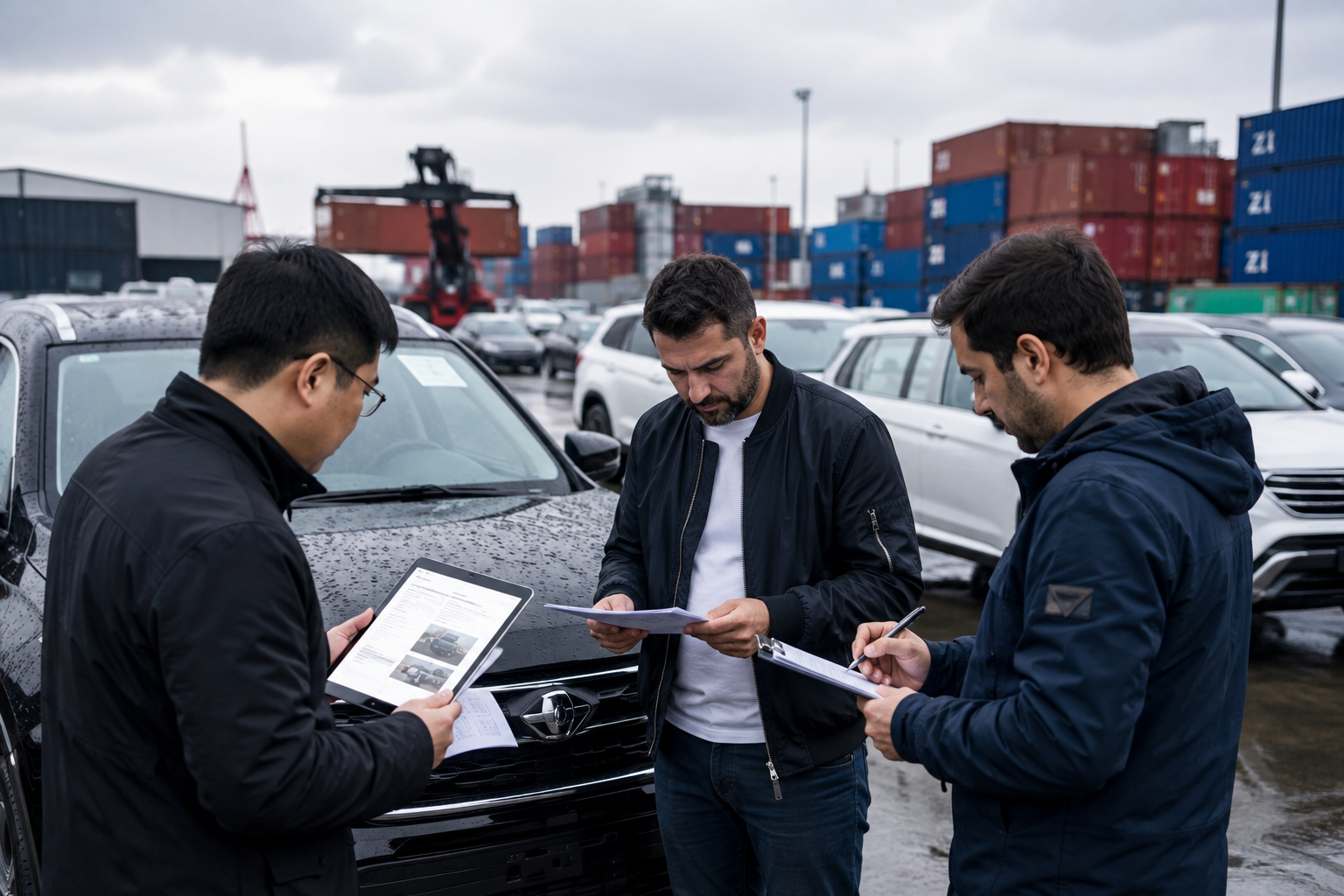
Before deposit, compare the China unit and the local version line by line. This is not a generic inspection checklist. It is a commercial equivalence test.
- VIN and high-resolution nameplate photo;
- production date, trim code and market version;
- new, demo, used or previously registered status;
- mileage photo and written mileage declaration;
- battery, engine, motor, drivetrain and charging specification;
- software language, app/account region, maps and OTA page;
- ADAS hardware and available functions on the actual vehicle;
- PDI photos or video tied to the offered unit;
- export readiness and supplier authority to export that VIN;
- refund treatment if export, documentation or destination eligibility fails.
Then ask the local partner one blunt question: would an end buyer, insurer, finance provider or fleet manager treat this China unit as equivalent to the local version?
Red Flags in China-Market Stock Bought for Resale
- The supplier says local warranty applies but cannot provide written VIN-specific proof.
- The model name matches the local car, but the supplier will not disclose trim code or VIN.
- Only brochure photos are available.
- Software language, app, account, OTA or map status is not shown live.
- No charge-port photo is provided for EV or PHEV stock.
- The seller presents grey-market inventory as official local stock.
- There is no service plan for a model already sold through an official network.
- The contract has no refund position if export or destination eligibility fails.
- The unit is recently registered in China but advertised as brand new without explanation.
- The transaction depends on undervaluation, false consignee data, incorrect HS classification, fake documents or informal customs workarounds.
What Bymotorcar Can Verify on the China Side
Bymotorcar is useful when the buyer already has a destination-market plan and needs China-side evidence before committing money.
We can help obtain or coordinate VIN/nameplate photos, trim and production status, PDI evidence, mileage proof, battery or engine data where available, supplier export readiness, export-side documents and FOB/FCA/CIF shipment information. For EVs, PHEVs and smart vehicles, we can also request live proof of charge port, interface language, software version, app/account status and warning-light condition.
That evidence helps the buyer, importer, broker, fleet manager or service partner decide whether the China-market unit is still the better commercial buy. It does not replace local compliance, registration, warranty, tax, insurance or after-sales confirmation.
FAQ: China-Market Cars vs Local Official Stock
Is a China-market car always cheaper than local official stock?
No. It may be cheaper at FOB, but the dealer must add freight, taxes, compliance, software work, parts reserve, warranty exposure, delay risk and resale discount.
Does local assembly make a Chinese car safer to buy?
Often, but not always. Local assembly can improve parts, warranty and service access, but the buyer still needs to compare price, specification, delivery time and demand.
Can the same Chinese model have different specifications by country?
Yes. The same badge may hide different batteries, charge ports, software, ADAS, emissions equipment, warranty terms or parts numbers.
Will a China-market vehicle receive local warranty support?
Do not assume it. Warranty coverage must be confirmed in writing by the relevant local warranty provider or distributor for the exact VIN.
When does direct China sourcing still make sense?
When the model or trim is unavailable locally, supply is delayed, the buyer has service capability, the price gap remains large after risk costs, or the order involves fleet or commercial specifications the local channel cannot supply.
What should dealers check before importing a China-market EV?
Charging port, battery data, software language, app region, OTA status, ADAS functions, parts support, local charging compatibility and high-voltage repair capability.
Why is VIN verification important before deposit?
The VIN ties the offer to a real unit. Without it, the buyer cannot compare market version, trim, battery, production status, warranty risk or export readiness.
Should a dealer import if the local official version is available?
Only if the China unit has a clear advantage after full risk-adjusted comparison. If the local version is similar and easier to service, local stock may be safer.
Sources and Further Reading
- Reuters: Chinese automakers open factories abroad — overview of Chinese OEM overseas production and assembly expansion.
- Reuters: BYD to start assembling electric cars in Brazil — BYD’s Brazil assembly plan using imported kits.
- Reuters: BYD Indonesia plant — example of Southeast Asia becoming a production and regional supply base.
- Geely: Egypt CKD plant launch — local production of Emgrand and Coolray in Egypt.
- BYD Thailand: Atto 3 standard-range launch — example of market-specific version and range variation.
- Reuters: China OTA regulatory approvals — why software and ADAS status should be checked as part of vehicle fit.
Compare a China-Market VIN Before Deposit
Comparing China-market stock with a local official version? Send Bymotorcar the target model, destination market, intended quantity and the local version you are using as a benchmark.
We can help verify the exact China-side VIN, nameplate, trim, production status, PDI evidence, battery or engine data, supplier export readiness and export-side documentation before you commit a deposit. Local compliance, import clearance, warranty, registration and after-sales support must be confirmed with your destination-market partners.