China launch analysis · Checked 9 October 2026
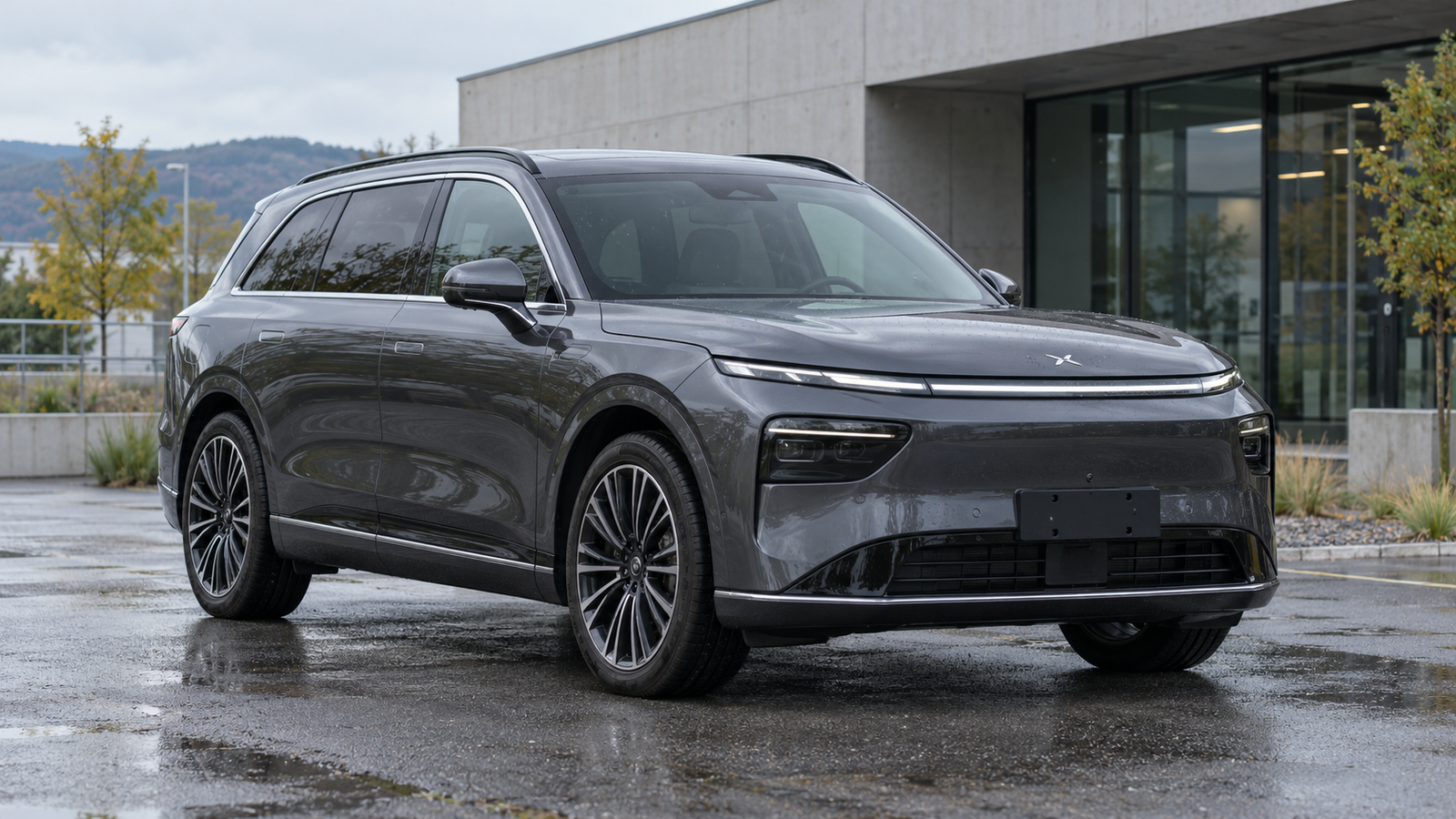
The XPENG G9L China launch on 17 September introduced a large five-seat SUV in battery-electric and range-extended forms. For an overseas buyer, however, the useful story is not the 755 km CLTC headline. It is the gap between a model sold in China, a pre-production vehicle built in Europe and a car cleared for sale in a particular destination.
Six BEV and REEV variants were announced with limited-time domestic pricing.
XPENG confirmed the first G9L production trial at Magna’s Austrian facility.
European order books and pricing are due to be presented at the Paris Motor Show.
One Model, Three Different Commercial Stages
The G9L can already be ordered through XPENG’s domestic sales system in China. That establishes the model’s existence, Chinese configurations and local price positioning. It does not make every Chinese-market car suitable for export or registration elsewhere.
The Graz milestone is different. XPENG says the first European pre-production vehicle was built at Magna’s complete-vehicle facility and would cover 1,324 km to Paris ahead of the global presentation. This is meaningful evidence of a European production programme, but a trial build is not the same as retail stock.
The third stage begins with the planned 12 October announcement. XPENG has spoken of availability across 64 global markets, yet buyers still need the actual country list, final local specifications, certification status, pricing and delivery calendar. A global rollout statement should not be treated as blanket approval in 64 jurisdictions.
What China Buyers Can Choose Today
The G9L is 5,120 mm long with a 3,100 mm wheelbase. Despite its size, it uses a five-seat cabin rather than a six- or seven-seat layout. XPENG’s China launch material lists four battery-electric variants and two range-extended variants.
| China variant | Powertrain | Drivetrain | China-rated range | Launch promotional price |
|---|---|---|---|---|
| 702 RWD Max | BEV | Rear-wheel drive | 702 km CLTC | RMB 231,800 |
| 660 AWD Ultra SE | BEV | All-wheel drive | 660 km CLTC | RMB 249,800 |
| 660 AWD Ultra | BEV | All-wheel drive | 660 km CLTC | RMB 279,800 |
| 755 AWD Ultra Flagship | BEV | All-wheel drive | 755 km CLTC | RMB 309,800 |
| 1602 AWD Ultra SE | REEV | All-wheel drive | 435 km EV / 1,602 km combined CLTC | RMB 249,800 |
| 1602 AWD Ultra Flagship | REEV | All-wheel drive | 435 km EV / 1,602 km combined CLTC | RMB 299,800 |
These are limited-time China-market prices published at launch. They are not FOB quotations and exclude export preparation, inland transport, freight, insurance, destination taxes and local compliance costs. CLTC figures are laboratory ratings, not a promise of real-world range.
Both powertrains use an 800-volt platform and XPENG’s 5C charging architecture. The company claims that the BEV can add 450 km of CLTC range in nine minutes under suitable charging conditions, while the REEV claim is 280 km in the same period. Those numbers describe the vehicle and test conditions used in China; an importer should first establish whether comparable high-power charging is available at the intended destination.
BEV or REEV Changes the Import Decision
Battery-electric G9L
The BEV is the cleaner proposition where dependable high-power charging, compatible connectors and trained EV technicians already exist. It also removes the petrol engine and fuel-system variables from the ownership equation.
Range-extended G9L
XPENG calls this version a REEV; many importers use the term EREV. Its engine generates electricity when the battery is depleted, which reduces dependence on public chargers but adds fuel-quality, engine-service and emissions-certification questions.
The choice is therefore not simply “longer range versus shorter range.” A dealer evaluating the REEV should confirm that the exact engine-emissions configuration can be certified locally and that service parts cover both the high-voltage system and the combustion engine. A dealer evaluating the BEV should map charging power, plug standards and customer parking patterns before choosing a trim.
Why the Five-Seat Layout Matters
At 5.12 metres, the G9L occupies the footprint of many three-row SUVs but devotes that space to five occupants and luggage. XPENG quotes a 1,152-litre main luggage compartment, a further 230-litre lower compartment and 66 cabin storage locations. Rear-wheel steering gives the large body a claimed 5.4-metre turning radius.
That package may suit premium family use, hotel transfers and executive fleets that value rear-seat comfort and luggage capacity more than maximum passenger count. It is a weaker fit for operators whose revenue depends on carrying six or seven people per trip. This is a basic commercial distinction, yet it is easy to miss when a launch presentation describes the car as offering the space of a six-seater.
Other China-market equipment includes dual-chamber air suspension, adaptive damping and XPENG’s VLA 2.0 driver-assistance system. Up to three in-house Turing AI chips are quoted at 2,250 TOPS. These computing figures should not be used to assume that every driver-assistance feature will operate in another country. Maps, connectivity, data rules, software language and feature activation may differ by market or vehicle configuration.
Global Testing Is Useful Evidence, Not Destination Approval
XPENG says the G9L completed three years of road testing across 26 countries and regions, covering 6.74 million kilometres. The company also cites 192 crash tests incorporating protocols from Euro NCAP, ANCAP, C-NCAP and CIASI. This is stronger evidence than a China-only development programme and helps explain why XPENG is preparing production in both Guangzhou and Graz.
It still does not answer the final import question. Testing against a standard and holding the certificate required to register one exact vehicle are not interchangeable. Approval can depend on the destination, model code, VIN, lighting, glass markings, charging inlet, radio equipment, emissions data and the documents supplied with the car.
The File to Request Before a G9L Purchase
An export quote is only useful when it identifies the vehicle behind it. Before comparing offers, ask the supplier to build an evidence file for the exact powertrain and destination.
- Vehicle identity: model code, production status, VIN or allocatable VIN, nameplate details and whether the unit is a China-market or destination-market specification.
- Powertrain evidence: battery capacity and supplier, drive layout, REEV engine data where applicable, plus the official configuration sheet for the quoted trim.
- Charging hardware: inlet standard, supplied cable, AC and DC limits, and confirmation that local charging networks can physically and electronically support the car.
- Software scope: available interface languages, navigation coverage, app registration, eSIM or data dependence, over-the-air update access and regional driver-assistance restrictions.
- Export condition: actual stock location, manufacture date, keys and accessories, pre-delivery inspection record, China export eligibility and the document chain included in the offer.
- Destination review: written feedback from the importer’s broker or certification body covering homologation, taxes, registration and any model-specific modification.
This approach also exposes misleading price comparisons. Two vehicles with the same English trim name can differ in hardware, software or documentation. The cheaper quote is not cheaper if it arrives with the wrong connector or without the evidence needed for customs and registration.
Who Should Watch the XPENG G9L?
The strongest early fit is likely to be an importer already serving premium electric-SUV customers, or a fleet that can control its own charging and maintenance environment. The REEV may widen the addressable market where charging coverage is uneven, but only after the engine and emissions configuration is accepted locally.
Buyers that need seven seats, a simple low-cost fleet vehicle or a model with a mature local parts network may be better served elsewhere. Bymotorcar’s China new-car listings and electric SUV category provide alternatives to compare by body type and powertrain rather than by launch publicity.
Frequently Asked Questions
Is the XPENG G9L already available outside China?
It is on sale in China. XPENG completed a European production trial in Graz and scheduled its global presentation, European price announcement and order opening for 12 October 2026. At the time of writing, availability and approval still need to be confirmed for each destination country.
Is RMB 231,800 the export price?
No. It was the starting limited-time price published for the China launch. An export quotation must separately account for the exact vehicle, domestic handling, export documents, port charges, freight, insurance and destination-side costs.
What is the difference between the G9L REEV and BEV?
The BEV relies entirely on its traction battery. The REEV drives electrically but carries a petrol engine to generate power when needed. The REEV can reduce charging dependence, while adding engine servicing, fuel and emissions-compliance considerations.
Does XPENG’s global testing guarantee local registration?
No. The testing programme supports the vehicle’s international-development case, but registration depends on the exact specification and the destination’s certification rules. The importer or local broker should review the VIN-level file before purchase.
Check a G9L Configuration Before Requesting Freight
Send the destination country, preferred BEV or REEV version, quantity and discharge port. We can check China-side vehicle identity, current supply status and available export documents so your local broker can assess the same configuration.
Request a VIN-level availability checkBymotorcar coordinates sourcing, vehicle checks, export documentation and shipping from China. Import taxes, destination certification, registration, warranty recognition and lawful local use remain subject to the buyer’s country and should be confirmed there.
- XPENG China launch announcement, 18 September 2026.
- XPENG global launch and international-development announcement, 18 September 2026.
- XPENG Graz production-trial announcement, 7 October 2026.