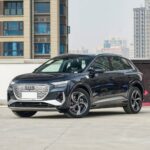
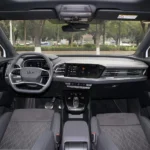
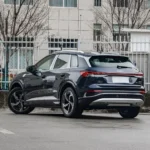
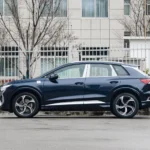
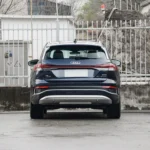
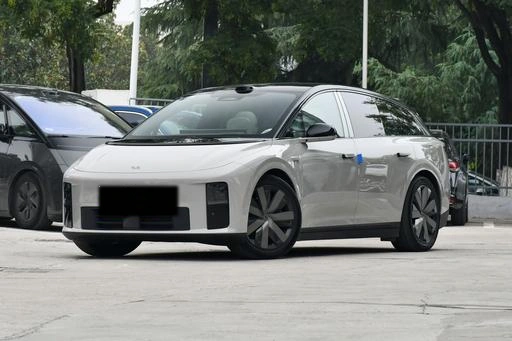
2024 Audi Q4 e-tron from China — export-focused trim comparison| Buyer Data | Q4 40 e-tron Chuangxing | Q4 40 e-tron Chuangjing / Yaoye | Q4 50 e-tron quattro Chuangjing Yaoye | Q4 50 e-tron quattro Chuangxiang Yaoye |
|---|
| China guide price | 289,900 RMB | 313,700–317,100 RMB | 332,700 RMB | 367,100 RMB |
| Estimated FOB reference | from US$31,900 | from US$34,500 | from US$37,900 | from US$41,500 |
| Export role | Lowest-cost Audi EV entry | Better equipment without quattro cost | Most balanced AWD export version | Top China-market Q4 e-tron spec |
| Production source | FAW-Volkswagen Audi, China | FAW-Volkswagen Audi, China | FAW-Volkswagen Audi, China | FAW-Volkswagen Audi, China |
| Vehicle type | Compact luxury electric SUV | Compact luxury electric SUV | Compact luxury electric SUV | Compact luxury electric SUV |
| Platform | Volkswagen Group MEB | Volkswagen Group MEB | Volkswagen Group MEB | Volkswagen Group MEB |
| Steering position | Left-hand drive | Left-hand drive | Left-hand drive | Left-hand drive |
| Seats | 5 | 5 | 5 | 5 |
| Length | 4,588 mm | 4,588 mm | 4,588 mm | 4,588 mm |
| Width | 1,865 mm | 1,865 mm | 1,865 mm | 1,865 mm |
| Height | 1,626 mm | 1,626 mm | 1,626 mm | 1,626 mm |
| Wheelbase | 2,764–2,765 mm | 2,764–2,765 mm | 2,765 mm | 2,765 mm |
| Ground clearance | 154 mm approx. | 154 mm approx. | 154 mm approx. | 154 mm approx. |
| Drag coefficient | 0.28 Cd | 0.28 Cd | 0.28 Cd | 0.28 Cd |
| Battery type | Ternary lithium | Ternary lithium | Ternary lithium | Ternary lithium |
| Battery capacity | 84.8 kWh | 84.8 kWh | 84.8 kWh | 84.8 kWh |
| Battery warranty reference | 8 years / 160,000 km | 8 years / 160,000 km | 8 years / 160,000 km | 8 years / 160,000 km |
| CLTC range | 605 km | 605 km | 560 km | 560 km |
| Motor layout | Rear single motor | Rear single motor | Front + rear dual motors | Front + rear dual motors |
| Maximum power | 150 kW / 204 hp | 150 kW / 204 hp | 230 kW / 313 hp | 230 kW / 313 hp |
| Maximum torque | 310 N·m | 310 N·m | 472 N·m | 472 N·m |
| Drive system | Rear-wheel drive | Rear-wheel drive | quattro all-wheel drive | quattro all-wheel drive |
| 0–100 km/h | 8.8 s | 8.8 s | 6.8 s | 6.8 s |
| 0–50 km/h | 3.3 s | 3.3 s | 3.0 s | 3.0 s |
| Top speed | 160 km/h | 160 km/h | 160 km/h | 160 km/h |
| Fast charging reference | about 0.68 h | about 0.68 h | about 0.68 h | about 0.68 h |
| Slow charging reference | about 12 h | about 12 h | about 12 h | about 12 h |
| China charge standard | Confirm GB/T port before export | Confirm GB/T port before export | Confirm GB/T port before export | Confirm GB/T port before export |
| Energy consumption | 14.4 kWh/100 km | 14.4 kWh/100 km | 15.5 kWh/100 km | 15.5 kWh/100 km |
| Curb weight | 2,160 kg approx. | 2,160 kg approx. | 2,255 kg approx. | 2,255 kg approx. |
| Gross weight | 2,640 kg approx. | 2,640 kg approx. | 2,720 kg approx. | 2,720 kg approx. |
| Luggage volume | 520 L approx. | 520 L approx. | 520 L approx. | 520 L approx. |
| Turning radius | 5.8 m approx. | 5.8 m approx. | 5.8 m approx. | 5.8 m approx. |
| Best buyer profile | Audi badge, lowest landed cost | Retail buyer wanting more comfort | Dealer wanting AWD credibility | Premium buyer wanting top China spec |
| Main export caution | Charging standard and warranty transfer | Software region and options proof | OCDC / recall status and quattro diagnostics | Higher parts cost and slower resale in price-sensitive markets |
The estimated FOB reference for the 2024 Audi Q4 e-tron from China starts from US$31,900, depending on supplier discount, production date, port, inspection scope and exact unit evidence. China-market units should not be treated as identical to U.S. or EU Q4 e-tron inventory: charge port, infotainment region, warranty coverage, recall status and documents must be checked before payment.
The 2024 Audi Q4 e-tron from China is not the newest EV SUV on paper, but it has a different advantage for overseas buyers: Audi brand trust, MEB-platform maturity and China-market pricing that can be more attractive than sourcing the same badge from Europe or North America. It fits buyers who want a recognized luxury EV badge without moving into a larger and more expensive Q8 e-tron.
For buyers comparing Audi inventory from China, start with the Audi sourcing category on Bymotorcar, then separate the Q4 e-tron by market version. A China-built FAW Audi Q4 e-tron is useful for left-hand-drive markets, but it should be quoted with China-spec assumptions until the charge port, software, documents and VIN evidence prove otherwise.
Why the China-built Q4 e-tron can still make sense
The Q4 e-tron is built on the Volkswagen Group MEB platform, the same broad EV architecture family used by models such as the Volkswagen ID.4 and Skoda Enyaq. That matters for export because the vehicle is not an experimental low-volume EV. It is a compact luxury SUV with a known platform, a known battery format and a body size that works for urban families, premium fleets and private buyers who want an Audi badge rather than a startup brand.
The China-market 2024 Q4 e-tron is especially interesting because its guide price and discount structure can put it into a different sourcing bracket. A buyer who sees an Audi EV as too expensive in the local showroom may accept a China-sourced unit if the savings are clear and the pre-shipment evidence is strong.
The 40 e-tron is the cleanest entry, not the most emotional trim
The rear-drive Q4 40 e-tron trims are easier to explain to cost-sensitive importers. They keep the 84.8 kWh ternary lithium battery, offer up to 605 km CLTC, and avoid the extra drivetrain complexity of quattro. For markets where the buyer wants a city-focused premium EV and has reliable home charging, the 40 e-tron can be the least risky version to quote.
The tradeoff is simple: it is not quick by modern Chinese EV standards. A buyer cross-shopping Xpeng, Zeekr, Nio or Tesla may see the 8.8-second 0–100 km/h figure as modest. The sales angle should be Audi refinement, brand recognition and predictable SUV packaging, not acceleration.
The 50 quattro needs recall and charging diligence
The Q4 50 e-tron quattro is more attractive for buyers who want all-wheel drive, stronger torque and a more premium trim story. It is also the version where a cautious exporter should slow down and verify more. Dual-motor EVs can be more persuasive for colder countries, hilly cities and buyers moving from gasoline premium SUVs, but they also raise the importance of drivetrain diagnostics and accurate trim proof.
Known recall topics around the Q4 e-tron family make pre-export screening more important than usual. Public recall records include charging-cable concerns, headlight control module software and on-board charger issues for certain 2024–2025 vehicles. That does not make the Q4 e-tron a bad sourcing candidate, but it does mean VIN-level recall checks should be part of the buying workflow rather than an afterthought.
Owner discussions point to charging behavior, not just battery size
Owner forums around the Q4 e-tron often focus less on the battery capacity itself and more on charging behavior: app scheduling, target-charge settings, smart charger handshakes and whether the vehicle or charger respects an 80% charge plan. This is exactly the kind of issue that matters for export customers, because a buyer in another country may not have the same Audi app support, dealer diagnostics or charger ecosystem as an original-market owner.
For that reason, the export inspection should include charging evidence, not just dashboard photos. Ask for port photos, charging cable photos, battery state-of-charge screenshots, infotainment language photos and a short charging test video when possible. If the destination country uses Type 2 / CCS2, a China-market GB/T unit needs a realistic charging plan before shipment.
Do not sell the warranty like a local Audi showroom would
The China domestic battery warranty reference is useful information, but it should not be presented as a guaranteed local warranty overseas. A parallel-export Audi may not receive the same warranty treatment in the buyer’s country, and software or recall work may depend on local dealer policy. This is one of the biggest differences between selling a new local Audi and sourcing an Audi Q4 e-tron from China.
The safer sales message is that Bymotorcar can help verify the exact unit before export: VIN, production date, nameplate, trim, battery data, mileage, PDI photos, charge accessories, port type and available export documents. The buyer should arrange local registration, charger compatibility and aftersales support before committing.
Best markets and buyer profile
The 2024 Audi Q4 e-tron from China is most suitable for left-hand-drive markets where Audi has strong recognition, EV charging is developing, and buyers value a premium badge more than headline acceleration. It can work for private buyers, executive fleets, boutique rental companies and dealers who want a recognizable European luxury EV without paying for a large flagship SUV.
It is less suitable for buyers who expect the latest 800V charging, full local Audi warranty, aggressive EV performance or trouble-free app services outside the original market. Those buyers may be better served by newer China-native EVs or by local-market Audi stock. For a serious quotation, use the official Audi China Q4 e-tron page as a starting reference, then verify the physical unit before payment.
Export recommendation
For most B2B inquiries, start with the Q4 40 e-tron if the buyer wants an Audi EV at the lowest practical landed cost. Move to the Q4 50 e-tron quattro only when the buyer specifically needs AWD, a stronger trim story or a higher perceived resale position. Before confirming either version, check the VIN for recall status, confirm the charge standard, document the exact trim and make sure the buyer understands that China-market software and warranty support may not behave like a local dealer car.