Updated: August 2026
Chinese Car Spare Parts Before Shipment: What Dealers Should Secure Before the First Batch
The first China car batch should not arrive alone. It should arrive with the evidence, parts plan and service path that let the dealer keep selling after the first customer needs repair.
Many overseas buyers spend weeks negotiating FOB price, VIN evidence, PDI photos and shipping terms. That work matters. But once the vehicles arrive, the real test often starts with something smaller: a headlamp, brake pad, 12V battery, ADAS sensor, charging cable, software fault or warranty question.
If the dealer cannot answer those issues, the first batch becomes a reputation risk instead of a profit center.
Dealer takeaway:
- A first batch from China should include VIN-matched parts information, not only vehicles.
- Fast-moving wear parts, crash-sensitive parts, diagnostics and warranty terms should be checked before shipment.
- A low FOB margin can disappear after one unavailable lamp, one immobilized EV or one unclear warranty claim.
Bymotorcar’s role: Bymotorcar can help with China-side vehicle sourcing, VIN/nameplate evidence, trim confirmation, PDI photos, supplier coordination, export-side documents, parts-information requests and FOB/FCA/CIF handoff where available. Local warranty, repair, diagnostic access, software unlocks, spare-parts availability, customs clearance, registration and insurance must be arranged by the buyer’s local partners.
A Low FOB Margin Can Disappear With One Missing Headlamp
The first batch is usually small: three SUVs, five EVs, ten pickups, twenty vans. The buyer sees margin in the China price. The problem is that the first repair can reveal whether that margin was real.
A minor accident can hold a vehicle for weeks if the bumper, headlamp, mirror, windshield or radar bracket is not available locally. This is not theoretical. In several export markets, repairers and insurers have raised concerns about Chinese cars because parts access and repair information did not keep pace with vehicle sales. Auto Express reported UK insurer concerns around parts shortages and repair support for some Chinese cars, while Reuters and AP later reported China’s move to tighten rules around near-new vehicles exported as used cars and require after-sales information for certain exports. Auto Express Reuters
The lesson for dealers is simple: do not treat spare parts as something to solve after the first customer complains. Build the support plan while the cars are still in China.
The Spare-Parts Starter Kit: What Dealers Should Prepare First
A starter kit does not mean filling a warehouse with random parts. It means preparing the items most likely to protect customer trust, resale confidence and basic service ability.
| Category | Typical items | Why it matters |
|---|---|---|
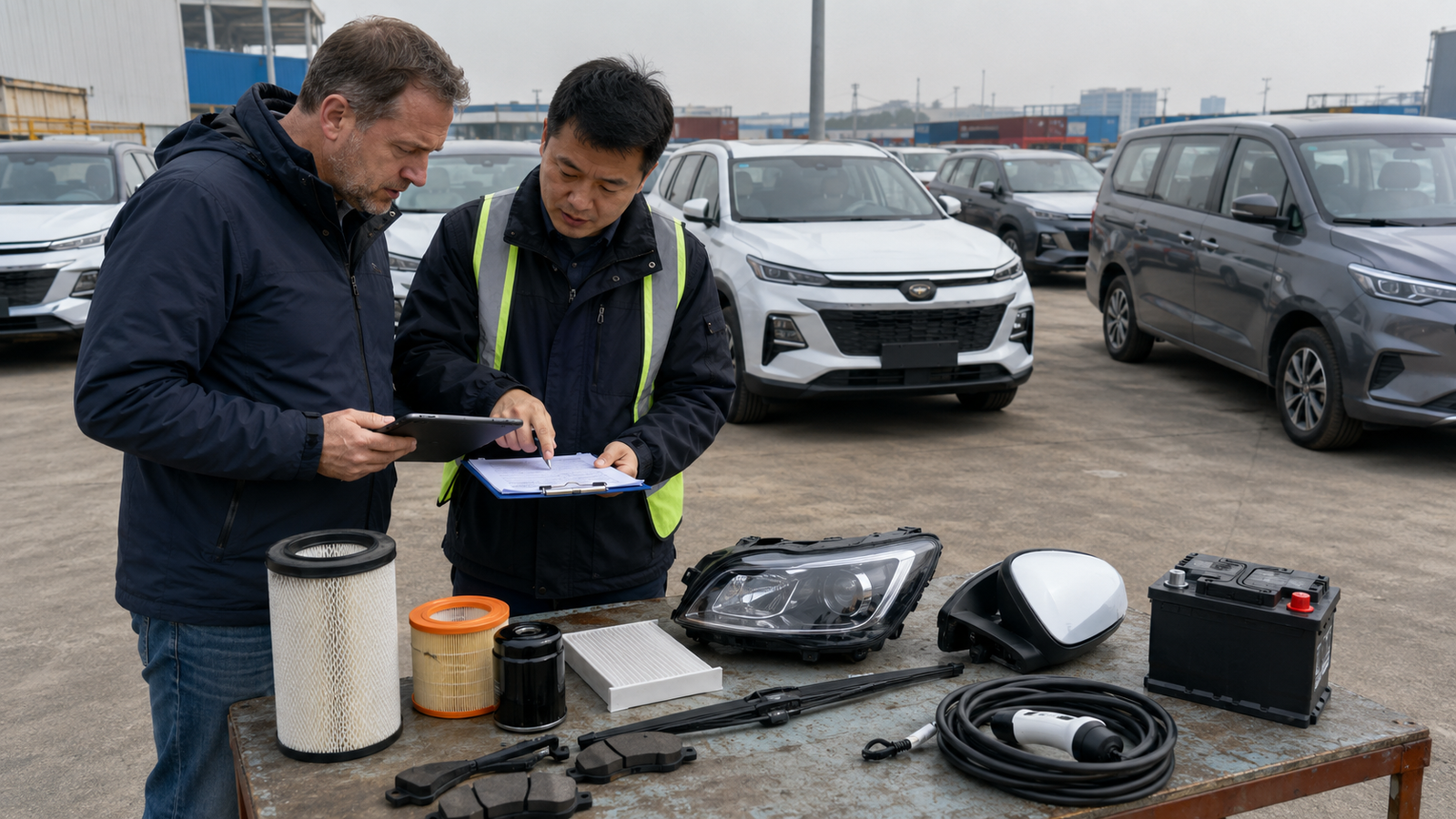
| Wear parts | Oil filter, air filter, cabin filter, brake pads, wipers, 12V battery, fuses, common bulbs. | These support routine service from day one and help the dealer look credible after delivery. |
| Crash-sensitive parts | Front bumper, grille, headlamps, taillamps, mirrors, windshield, clips, sensor brackets. | Small accidents can become long delays if these parts are not planned before shipment. |
| EV / PHEV items | Charging cable, adapter strategy, 12V battery, coolant spec, charging-port parts, diagnostic pathway. | Electrified vehicles need safe service support, not only a good range figure. |
| Commercial vehicle parts | Belts, hoses, filters, brake chambers, clutch parts, suspension bushings, lamps, wheel bearings. | For trucks, pickups and buses, downtime is a business cost, not an inconvenience. |
The kit should match the platform and the duty cycle. A city EV dealer, an African pickup buyer and a bus operator should not order the same parts package.
VIN-Matched Parts: Why Model Names Are Not Enough
“It is a Chery,” “it is a BYD,” or “it is a Geely SUV” is not enough information for parts planning. China-market vehicles can differ by trim, facelift, battery supplier, lighting package, ADAS hardware, charging port, engine, gearbox or steering configuration.
Before shipment, ask the supplier to connect the parts plan to the actual units:
- full VIN for every vehicle;
- nameplate photos and production date;
- exact trim and market version;
- OE part numbers for filters, brake pads, lamps, mirrors and 12V battery;
- photos of installed parts and labels where possible;
- confirmation of facelift or pre-facelift version;
- charging port and cable package for EV/PHEV stock;
- ADAS sensor layout for vehicles with radar or camera systems.
Do not assume that local official dealer parts will fit a China-market parallel-import VIN. Sometimes they do; sometimes the difference only appears when a customer is already waiting for a repair.
EVs, PHEVs and Smart Cars Need a Different Service Plan
EVs and PHEVs are not just “cars with fewer oil changes.” They bring different service questions: high-voltage safety, battery diagnostics, charging compatibility, thermal management, software language, app access, OTA behavior and warning-light interpretation.
For an EV or PHEV batch, the dealer should secure evidence before shipment:
- charging cable and adapter package;
- AC/DC charging port photos;
- 12V battery specification;
- coolant type and thermal-management notes;
- battery health or diagnostic data when available;
- software version, language menu and OTA screen;
- clear plan for who can diagnose battery, motor, inverter and BMS faults locally.
High-voltage modules should not be stocked casually by small dealers. The more urgent question is whether the buyer has a safe diagnostic and repair pathway. Without that, even a minor electrical fault can become a long immobilization.
Diagnostics and Workshop Readiness Before Shipment
A generic OBD scanner may read basic engine data, but that does not mean the workshop is ready for a China-market smart EV, PHEV or ADAS-equipped SUV. The buyer should separate service readiness into four levels.
| Vehicle type | Minimum readiness |
|---|---|
| Basic ICE vehicle | OBD support, service intervals, filter and brake part numbers, workshop familiarity. |
| EV / PHEV | High-voltage safety training, diagnostic route, charging evidence, battery-support plan. |
| Smart vehicle / ADAS | Camera/radar calibration plan, software status, error-code support, sensor replacement process. |
| Truck / bus / fleet vehicle | Manuals, torque data, brake and suspension parts, driveline specs, preventive maintenance schedule. |
Bymotorcar can help ask China-side suppliers for available service manuals, part numbers, maintenance notes and diagnostic references. Brand-authorized tools, high-voltage repair, ADAS calibration and local workshop capability must still be arranged in the buyer’s market.
Warranty Promises Are Not a Service Strategy
“Warranty available” is not a complete answer. The dealer needs to know who pays, who repairs, where repairs happen, what parts are covered and how long the customer may wait.
There are usually three different warranty situations:
- Local official warranty: applies through a brand’s local authorized network, usually only for vehicles sold through that channel.
- Exporter or seller warranty: a commercial promise from the seller, which must be written clearly and may require shipping parts from China.
- No practical warranty: common for some China-market, used, demo or registered stock unless the buyer creates their own service reserve.
For small dealers, a realistic parts reserve and a written repair process are often more valuable than a vague warranty promise. If the buyer cannot explain warranty handling to the first retail customer, the batch is not ready.
How Many Parts Should a Dealer Order With the First Batch?
There is no universal formula. The right stock level depends on model count, local support, expected mileage, climate, road conditions and whether the buyer is a retail dealer, fleet operator or trader.
| Batch size | Planning principle |
|---|---|
| 1–3 vehicles | Focus on VIN evidence, part numbers, filters, brake pads and any critical body part that affects resale. |
| 5–10 vehicles | Stock basic service items and one small crash-sensitive set per platform if the model is uncommon locally. |
| 10–30 vehicles | Build a structured starter kit and agree a reorder channel with lead times and minimum order quantities. |
| Fleet orders | Plan around duty cycle: maintenance schedule, wear parts, emergency parts, technician training and uptime target. |
Another simple rule: avoid importing ten different models in your first ten vehicles. A concentrated first batch makes parts planning, technician learning and customer support much easier.
Buyer Scenarios: Same China Price, Different Parts Risk
Small SUV Dealer
Needs lamps, mirrors, filters, brake parts and part numbers before resale begins. The risk is not buying the SUV; it is keeping the first customer mobile.
EV Fleet Buyer
Needs charging proof, high-voltage safety, battery diagnostics and a workshop plan before shipment. A cheap EV with no repair route is not fleet stock.
Pickup Buyer
For construction, mining or farm use, filters, belts, suspension parts, tyres and brake components matter more than extra screen size.
Bus Operator
Needs uptime. The spare-parts kit should follow route, passenger load, brake wear, suspension stress and maintenance schedule.
Red Flags Before Paying a China Supplier
- The supplier cannot provide VINs for every unit.
- The offer uses only model names, not exact trims or market versions.
- No part numbers are available for filters, brake parts, lamps or mirrors.
- The seller says “parts are easy” but gives no source, catalogue or reorder contact.
- There is no local workshop plan, especially for EVs, PHEVs or ADAS-equipped vehicles.
- Warranty is promised without a written payer, repair location or claims process.
- The buyer has no diagnostic method beyond generic OBD for a smart EV.
- The first batch includes too many different models and platforms.
- Registered or used stock is offered with unclear warranty and after-sales support.
- The local official dealer may refuse to support China-market VINs, and no one has checked.
What Bymotorcar Can Verify on the China Side
Bymotorcar can help buyers reduce guesswork before shipment. We can request VIN and nameplate photos, confirm trim and market version, collect PDI evidence, ask suppliers for part numbers, request available service or maintenance information, check charging cables and software-language evidence, and coordinate parts-package discussions alongside the vehicle shipment.
This China-side evidence helps the buyer decide whether the first batch can be sold and supported after arrival. It does not replace local warranty, repair, diagnostic authorization, high-voltage training, customs clearance, registration or insurance.
FAQ: Chinese Car Spare Parts Before Shipment
What spare parts should a dealer order with the first batch of Chinese cars?
Start with VIN-matched service items: filters, brake pads, wipers, 12V battery, common bulbs and essential clips. For uncommon models, add selected lamps, mirrors, bumper parts or windshield planning.
How can I check if Chinese car parts are available before importing?
Ask for full VINs, OE part numbers, component photos, catalogue screenshots where available, supplier reorder contact and expected lead times for wear and crash parts.
Do Chinese EV warranties transfer automatically overseas?
Do not assume that. Domestic China warranties, export warranties, seller warranties and local distributor warranties are different. The buyer needs written terms for the exact vehicle and market.
Which parts can usually be sourced locally?
Some consumables such as tyres, 12V batteries, fluids, bulbs and basic filters may have local alternatives once specifications are known. Trim-specific lamps, bumpers, ADAS sensors, ECUs and EV components often require China sourcing.
Why should parts be matched by VIN?
The same model name can hide different facelifts, trims, ADAS packages, battery suppliers, charging ports or market versions. VIN matching reduces wrong-part risk.
What diagnostic tools do Chinese EVs need?
Basic OBD may not be enough. EVs and smart vehicles may need brand-compatible tools, high-voltage safety procedures, battery diagnostics, software support and ADAS calibration capability.
Should I import many different Chinese models in my first batch?
Usually not. A focused first batch built around one or two platforms is easier to support with parts, training and customer service.
Can Bymotorcar supply local repair or warranty?
No. Bymotorcar can help with China-side vehicle evidence, supplier coordination, parts-information requests and export handoff. Local repair and warranty must be arranged by the buyer’s service partners.
Sources and Further Reading
- SCIO / CPCA: China auto exports up 23% in 2024
- IEA Global EV Outlook 2026: manufacturing and trade
- Auto Express: parts and repair support concerns for some Chinese cars
- Reuters: China tightens oversight on new cars exported as used vehicles
- AP: China cracks down on “zero-mileage” car exports
- GAC: European spare-parts distribution center
Build the Parts Plan Before the Cars Leave China
If you are planning a first batch from China, send Bymotorcar the target models, destination market, quantity, buyer type and intended service plan.
We can help verify exact VINs, trims, PDI evidence and China-side parts information, then coordinate vehicle and parts discussions with suppliers before shipment. Local warranty, repair, diagnostic tools and after-sales support must still be arranged with your own service partners, but you do not have to guess about what is leaving China.