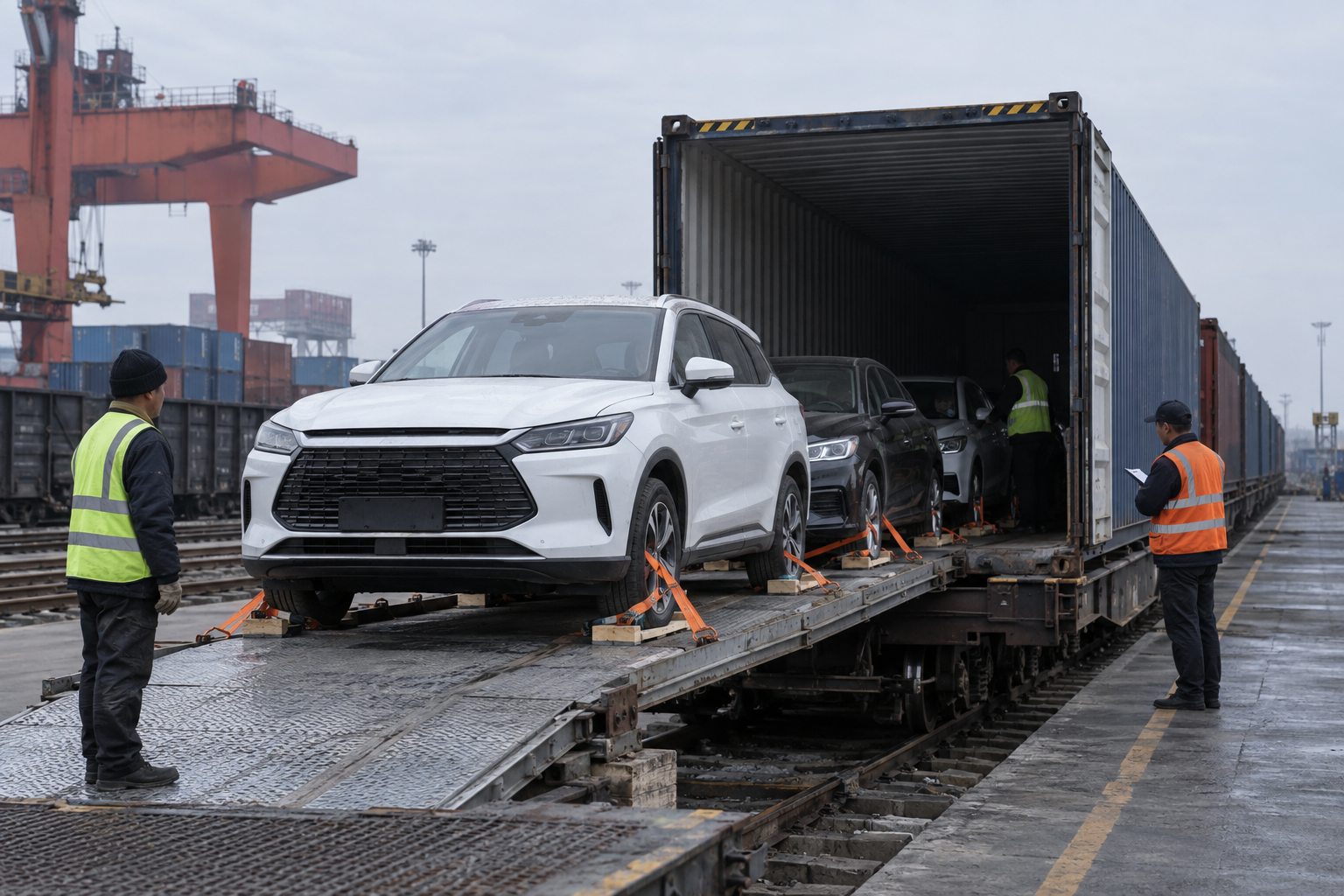
A car can clear customs in Belarus and still fail to reach the registration desk with the right technical file. That is the central risk when buyers import cars from China to Belarus: the attractive China price is only useful after the exact vehicle, importer and route have passed three separate checks.
The Three Checks To Finish Before Payment
Can the exact model and VIN obtain the conformity evidence needed in Belarus?
Is the buyer importing for personal use or as commercial stock, and how will customs classify the vehicle?
Will the banks, exporter, carrier and consignee accept the same transaction and document set?
This guide is written for Belarus dealers, fleet buyers and private importers buying new or used Chinese vehicles. It does not publish a universal landed-cost percentage because Belarus treats personal and commercial imports differently, and the result changes with age, value, engine displacement, powertrain and customs classification.
First Gate: Can This Exact Vehicle Be Registered?
Belarus follows the Eurasian Economic Union vehicle-safety framework, principally TR CU 018/2011. A Chinese MIIT listing, CCC certificate or domestic brochure helps identify the vehicle, but it does not replace the conformity evidence required for circulation in the EAEU market.
The approval route depends on who imports the vehicle and whether it is a one-off unit, a small batch or a serial commercial model. The acronyms are easy to mix up, so they should be treated as different parts of the file.
| Term | What it means in practice | Buyer question |
|---|---|---|
| OTTS | Vehicle type approval generally associated with a serial vehicle type. | Does this exact type already have valid approval, and does the VIN specification match it? |
| SBKTS | Safety certificate for an eligible individual vehicle. | Will an accredited Belarus body accept this unit and its technical evidence? |
| ZOETS | A Belarus single-vehicle assessment conclusion used only where the national procedure applies. | Is the importer and vehicle eligible under the procedure in force on the application date? |
| EAC mark | A conformity marking, not a substitute for the underlying approval file. | Which approval document supports the mark for this vehicle? |
| EPTS | The EAEU electronic vehicle passport used in the registration chain. | Who will create the record after customs and conformity steps are complete? |
For a private one-car purchase, ask an accredited Belarus laboratory for a written pre-assessment using the VIN, model code, build date, engine or motor data, gross weight and clear nameplate photographs. For dealer stock, do not assume that a route accepted for one private vehicle can be repeated across a batch.
Do not ship on a verbal “EAC available” promise. Ask which document will be issued, which body will issue it, what tests or evidence are needed and whether the same route applies to the intended importer.
Left-hand drive and vehicle condition
Bymotorcar should quote a left-hand-drive configuration for Belarus. Steering position must be verified from the physical car, VIN evidence and factory specification rather than a stock photo. Damaged, incomplete or modified vehicles need separate technical review; customs release alone does not cure visible damage, missing safety components or an unapproved conversion.
Second Gate: Use the Correct Customs Regime
The official EAEU schedule provides unified duty-and-tax rates for passenger cars imported by individuals for personal use. Those figures are useful, but they are not dealer rates and should never be pasted into a commercial quotation for resale stock.
Personal-use passenger cars up to three years old
Rate reference: EAEU Decision No. 107 personal-use schedule, reviewed in September 2026. Reconfirm the applicable schedule, customs value and vehicle age with the declarant before filing.
| Customs value | Unified rate |
|---|---|
| Up to EUR 8,500 | 54% of value, minimum EUR 2.50 per cm3 |
| Over EUR 8,500 to EUR 16,700 | 48%, minimum EUR 3.50 per cm3 |
| Over EUR 16,700 to EUR 42,300 | 48%, minimum EUR 5.50 per cm3 |
| Over EUR 42,300 to EUR 84,500 | 48%, minimum EUR 7.50 per cm3 |
| Over EUR 84,500 to EUR 169,000 | 48%, minimum EUR 15 per cm3 |
| Over EUR 169,000 | 48%, minimum EUR 20 per cm3 |
Personal-use passenger cars more than three years old
Rate reference: These engine-displacement bands come from the same EAEU personal-use schedule. They are not commercial dealer-import rates.
| Engine displacement | More than 3, up to 5 years | More than 5 years |
|---|---|---|
| Up to 1,000 cm3 | EUR 1.50 per cm3 | EUR 3.00 per cm3 |
| 1,001 to 1,500 cm3 | EUR 1.70 per cm3 | EUR 3.20 per cm3 |
| 1,501 to 1,800 cm3 | EUR 2.50 per cm3 | EUR 3.50 per cm3 |
| 1,801 to 2,300 cm3 | EUR 2.70 per cm3 | EUR 4.80 per cm3 |
| 2,301 to 3,000 cm3 | EUR 3.00 per cm3 | EUR 5.00 per cm3 |
| Over 3,000 cm3 | EUR 3.60 per cm3 | EUR 5.70 per cm3 |
For a car up to three years old, customs compares the percentage result with the engine-displacement minimum and uses the higher amount. Older-car rates are generally calculated from engine displacement and age. The broker must still confirm the legally relevant production date, customs value and personal-use eligibility.
Dealer and company imports
A Belarus company importing vehicles for resale uses the commercial customs regime. The calculation can involve the EAEU commodity code, customs value, import duty, Belarus VAT, excise where applicable, recycling fee, customs-operation charges and conformity costs. Pickups, vans and high-seat-count vehicles may not fall under the passenger-car treatment a seller expects.
This guide deliberately does not quote one company-import percentage. A petrol SUV, pure EV, PHEV and light commercial vehicle can produce different classifications. Ask the declarant for a written calculation tied to the exact model, powertrain, age, value and intended importer.
EV caution: the personal-use schedule lists pure battery vehicles separately, but that alone does not prove a zero-duty Belarus exemption in September 2026. Any exemption, quota or reduced rate must be confirmed for the declaration date. A PHEV or range extender should not be declared as a pure EV merely because it can drive electrically.
China Documents Must Match the Belarus File
A clean import starts with one vehicle identity. The VIN, legal manufacturer, model code, production date, engine or motor data, battery information, gross weight, seat count, seller, buyer and consignee should agree across the contract, invoice, export declaration, transport document and conformity application.
| China-side document or evidence | Why the Belarus buyer needs it |
|---|---|
| Sales contract and commercial invoice | Connect the parties, VIN, price, Incoterm, payment and refund obligations. |
| VIN, nameplate and factory specification | Give the broker and certification body the exact vehicle identity before shipment. |
| China export customs declaration | Supports lawful export and aligns the goods description with the transport file. |
| Packing list where applicable | Identifies container contents, accessories and multiple VINs. |
| Rail waybill, CMR or bill of lading | Shows the contracted route, consignor, consignee and cargo handoff. |
| Chinese registration and export-transfer records for used vehicles | Prove status, dates and ownership history used in the export-licence process. |
| PDI and condition evidence | Records mileage, visible condition, warning lights, accessories and loading condition. |
| Technical data for certification | Supports category, mass, seats, emissions, battery and powertrain review. |
The 180-day export check for recently registered cars
China tightened its used-vehicle export controls from 1 January 2026. When an export-licence application is made within 180 days of first registration, the file requires a manufacturer-issued confirmation covering overseas after-sales service. The brand, model and registration dates must also agree with the Chinese vehicle record.
That rule matters to Belarus buyers looking at low-mileage or “zero-mileage used” offers. An invoice from a trader is not evidence that the exact VIN can obtain its export licence. The contract should state what happens to the deposit if export authorization is refused or delayed.
For broader China-side workflow, see Bymotorcar’s vehicle import guide.
Third Gate: Make the Payment and Route Bankable
Belarus-related sanctions and bank controls change over time. That does not mean every China-to-Belarus vehicle transaction is prohibited. It does mean that a deal can be lawful in principle and still be rejected by a payer bank, beneficiary bank, correspondent, carrier or insurer.
Before funds move, both sides should confirm the seller’s full legal name, beneficiary account, receiving bank, currency, contract wording, vehicle description, payer and consignee relationship, refund route and any bank request for VIN or export-licence evidence. Payment to an employee, unrelated company, personal account or cryptocurrency wallet is not a practical substitute for a traceable trade file.
Rail is practical, but the quote must name the handoff
Container rail is a documented route from Chinese hubs such as Chengdu or Chongqing to the Kolyadichi terminal in Minsk. It can suit a single vehicle in consolidation or a dealer batch, while protecting the cars inside a container. The trade-off is consolidation time, wagon capacity, border handling and terminal congestion.
A usable rail quotation should specify the China collection point, loading plan, container size, number of vehicles, battery status, waybill consignee, transit route, Kolyadichi handling, insurance and final delivery responsibility. A quoted transit time is a schedule estimate, not a registration timeline.
Road movement through Kazakhstan and Russia may offer more flexible pickup or small-batch handoff, but permits, border queues, insurance and carrier compliance need written confirmation. Sea-plus-land routing through a Baltic port is more compliance-sensitive and should only be booked after the forwarder validates every carrier and transit leg.
Which Chinese Vehicles Fit Belarus Better?
This is a buyer-side assessment, not a registration guarantee. Belarus has cold winters, meaningful intercity driving and a used-car market that cares about parts and resale. A technically impressive China model can still be a weak import if its charging, software or warranty is locked to the domestic market.
| Vehicle type | Where it can make sense | Checks that decide the order |
|---|---|---|
| Pure EV | Urban users, taxis or fleets with reliable home or depot charging. | Battery heating, winter range, GB/T or CCS2 compatibility, DC charging, software and battery support. |
| PHEV or range extender | Mixed city and intercity use where charging exists but cannot cover every trip. | Customs classification, cold-start behavior, fuel system, charging connector and high-voltage service. |
| Petrol SUV | Regional dealers and buyers prioritizing refuelling, road clearance and familiar servicing. | Fuel grade, winter package, corrosion protection, suspension, parts and Russian-language diagnostics. |
| Sedan or MPV | Taxi, private hire, company transport and family use. | Heating, ground clearance, approved seat count, luggage space and commercial-use category. |
| Van or pickup | Delivery, agriculture, construction and service fleets. | N or M category, payload, gross weight, duty code, body configuration and local fleet parts. |
For an EV or PHEV, request photographs of the AC and DC inlets, charger labels and supplied cable. A physical adapter does not necessarily translate the charging protocol. Battery pre-heating, low-temperature charging limits, cabin heating and underbody protection matter more in Belarus than the headline CLTC range.
Our EV shipping checklist explains the VIN, battery, charging-accessory and carrier evidence to collect before loading.
A Practical Import Sequence
| Stage | Owner | Evidence needed before moving on |
|---|---|---|
| 1. Select the exact vehicle | Buyer and China supplier | VIN, nameplate, build date, trim, status, mileage and condition file. |
| 2. Pre-check conformity | Belarus certification body | Written OTTS, SBKTS or other applicable route for that vehicle and importer. |
| 3. Classify the import | Belarus customs declarant | Importer regime, HS code, customs value basis and dated local-cost calculation. |
| 4. Clear the payment route | Buyer, seller and banks | Accepted parties, currency, description, beneficiary and refund path. |
| 5. Sign the contract | Buyer and seller | VIN or substitution rules, Incoterm, document list, payment stages and refund triggers. |
| 6. Complete China export work | Exporter | Export eligibility, declaration and used-car licence file where applicable. |
| 7. Book transport | Forwarder | Written route, loading method, carrier acceptance, insurance and handoff points. |
| 8. Clear and register in Belarus | Importer and local partners | Customs release, conformity evidence, EPTS, fees, inspection, insurance and registration file. |
Four Reasons To Stop the Order
- No written conformity route. The seller says “EAC is possible,” but no accredited Belarus body has reviewed the exact specification.
- No importer-specific customs calculation. A dealer quotation uses a private individual’s duty table, or a PHEV is priced as a pure EV without classification evidence.
- No clean export path from China. The recently registered car is advertised as ready, but the supplier cannot show how the 180-day rule will be satisfied.
- No bank-approved payment chain. The contract party, beneficiary, payer or consignee does not match, or the route depends on a misleading goods description.
Software language, navigation and connected apps matter, but they are usually fixable commercial issues. Certification eligibility, customs classification, export authority and payment legality can stop the shipment entirely. Resolve them in that order.
What Bymotorcar Handles on the China Side
Bymotorcar can source suitable left-hand-drive vehicles, collect VIN and nameplate evidence, verify trim, mileage and visible condition, coordinate PDI photos or video, check China registration status, align supplier documents and support China-side export and FOB, FCA or CIF handoff where available.
Belarus customs clearance, duty and tax calculation, OTTS or single-vehicle assessment, EPTS, local registration, insurance, warranty, repairs and payment approval remain with the buyer’s Belarus broker, certification body, bank and service partners. That division should be agreed before the vehicle is ordered.
FAQ: Importing Chinese Cars to Belarus
Is Belarus part of the EAEU vehicle system?
Yes. Belarus applies the EAEU framework, including TR CU 018/2011 for wheeled-vehicle safety. National procedures can still differ, so a Russia import file should not be copied without Belarus review.
Does customs clearance mean the car can be registered?
No. Customs release, conformity assessment, EPTS and registration are separate stages. The exact approval path should be checked before shipment.
Can a dealer use the personal-use duty table?
Not for commercial stock. The unified rates shown above apply to qualifying individual personal imports. A dealer or company needs a commercial calculation based on the actual commodity code and importer.
Are Chinese EVs duty-free in Belarus in 2026?
This guide does not make that claim. Any current exemption, quota or reduced rate must be confirmed with the EEC position and Belarus customs for the declaration date and exact vehicle classification.
What is the most practical shipping route from China?
Container rail to the Minsk area is a documented option for individual vehicles in consolidation and dealer batches. Road or multimodal routes can also work, but the forwarder must confirm the current route, carrier, insurance, sanctions checks and handoff points.
Can I import a used Chinese EV to Belarus?
Potentially, but the exact car needs a valid China used-vehicle export file, a workable Belarus conformity route and a customs classification confirmed by the local declarant. Buyers should also review battery condition, charging compatibility, winter performance, software access and parts support before shipment.
What should I send for an SBKTS pre-assessment?
The accredited body should provide the final list for the exact vehicle. A useful starting file normally includes the VIN and nameplate, factory specification, production date, ownership or registration record, engine or motor data, battery data for electrified vehicles, gross weight, seat count and clear vehicle photographs. Obtain written confirmation of any testing or additional evidence before shipping.
What should I send for a pre-order vehicle check?
Send the target model, model year, powertrain, quantity, destination city and intended importer type. If a specific vehicle is already selected, include the VIN, nameplate photo and seller’s specification sheet.
Sources and Further Reading
- Eurasian Economic Commission: TR CU 018/2011 vehicle-safety regulation
- Eurasian Economic Commission: personal-use vehicle duty schedule, Decision No. 107
- China Ministry of Commerce: strengthened used-vehicle export rules effective in 2026
- Transconsult Brest: China-to-Kolyadichi container rail workflow
- Council of the European Union: current Belarus sanctions timeline
- US Treasury OFAC: March 2026 Belarus actions and general licence update
Review the Vehicle Before You Commit Funds
Send us the model, quantity, powertrain and destination city. We can verify the China-side VIN evidence, registration status and export-readiness records, then organize the file for review by your Belarus broker and certification body.